
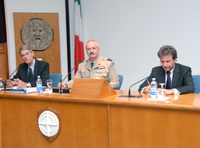
The aim of the Study Period (SP) is to “analyze global security challenges and the possible implications for NATO”. The NATO Executive Development Program (NEDP) and Modular Short Course (MSC) 4 joined the Senior Course (SC) for the SP, as well as many visiting Embassy staff.
Earlier in the Course, SC 117 had the opportunity to propose a vision of the world in 2025, outlining the future security environment within which NATO must work. SP D provided the chance to hear from experts in a number of specific fields to further inform committee views. At the end of the SP, committees will have the opportunity to identify, by consensus, the topic deemed most relevant to NATO, and develop recommendations and offer them to the supervising Flag Officer and Faculty Advisor in the form of a presentation. The lecture content of SP D was as follows:
On Monday 15 November Dr Nazrin Mehdiyeva presented the lecture “Energy Security”. Dr Mehdiyeva is a leading energy consultant providing strategic, commercial, regulatory and policy advice to Europe’s energy markets. Dr Mehdiyeva offered an excellent lecture covering numerous global energy issues, with valuable and thought provoking ideas for NATO’s role in Energy Security.
Dr Mehdiyeva was joined by Dr Arif Husain from the WFP who covered issues of Food and Water scarcity. Dr Husain provided an authoritative assessment of the world’s Food and Water hotspots, linking the issues of energy commodities with food commodities in a clear way for the audience to consider. Dr Husain was equally clear on how the WFP is engaged globally and the audience was treated to a most informative lecture and a useful, combined Question and Answer session.
On Tuesday 16 Nov “The Environment and Consequences of Climate Change” was delivered, once again by Professor Gwyn Prins and Dr Bruno Tertrais. Professor Gwyn Prins provided a critical overview of the various Climate Change summits and offered challenging views on Climate Change Policy. Dr Tertrais provided an analytical assessment of the relevance to NATO, and Defence and Security institutions, of the consequences of climate change. The combined day provided a fascinating and challenging perspective on the topic, and a clear catalyst for animated committee debate.
On Wednesday 17 Nov “Demography and Migration” was delivered by Prof Simoncini and Professor Peter Liotta. Professor Simoncini offered a forthright analysis of migration pressures on states and two very good case studies to underline his point. Prof Liotta similarly provided a fascinating and engaging brief on long-term global demographic trends, migration and the inter-related risks that this posed the world community. Overall, a very successful day with keen engagement from Course Members.
On Thursday 18 Nov “Terrorism” was delivered by Prof Edwin Bakker from the Clingendael. Prof Bakker, once again, offered an excellent overview of the phenomenon of Terrorism and its possible future trends, fielding many challenging questions during Q&A. The morning equipped committee members well for their afternoon intercommittee debate on the subject of Terrorism and deterrence.
On Tuesday 23 Nov “Organised Crime” was presented by Dr Christina Schori-Liang from the Geneva Centre for Security Policy (GCSP) and Mr Pierre Reuland from INTERPOL. Both speakers provided a fascinating overview of International crime and criminality, stressing the complexity of global organized crime and its interaction with Terrorist organizations. In particular, Mr Reuland complimented excellent discussion points raised by Dr Schori Liang, by offering an Interpol perspective, outlining the key contribution INTERPOL makes in combating organized and international crime, as well as offering suggestions for future cooperative improvements.
The Study Period concluded on Thursday 25 Nov with Professor Dr Holger Mey, political analyst and head of Advanced Concepts, EADS, Munich, and Mr Edmund Whiteside (NATO/CAN) Secretary of the North Atlantic Council, with a lecture on “Weapons of Mass Destruction, Proliferation and Arms Control”. Professor Mey offered a clear, fascinating and thought provoking analysis of the key issues, challenging CMs to think through the logic of proliferation, with additional thoughts on ballistic Missile defence. Mr Whiteside offered a challenging and detailed assessment of the issues inherent in any discussion on WMD and proliferation, including a useful focus on the very recently published NATO Strategic Concept and Communique.
Throughout the six days of “Global Security Challenges” CMs engaged in lively “Question and Answer” sessions, held intercommittee discussion and debate, and all with a copy of the newly published NATO Strategic Concept and Lisbon Summit Communique to hand. Timing was perfect for a successful SP.
NDC Public Affairs Office

 Collège de Défense de l'OTAN