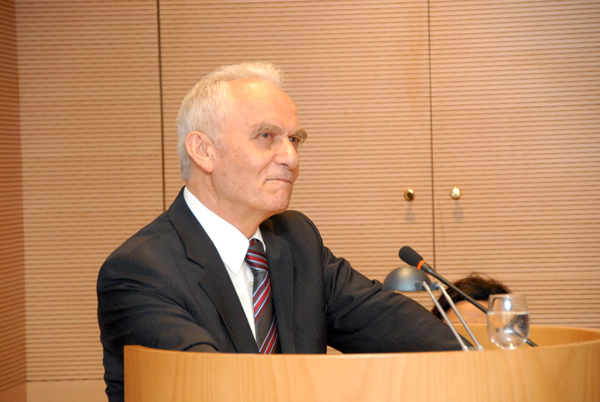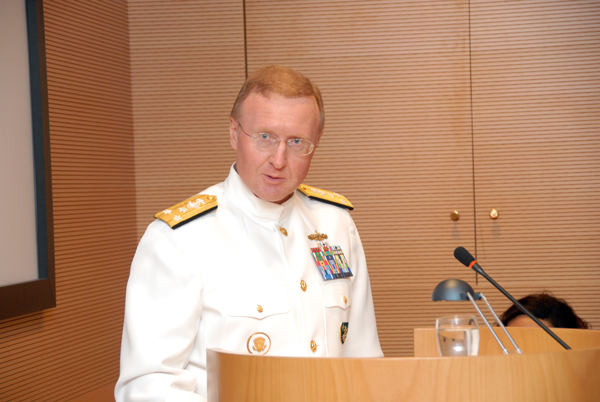

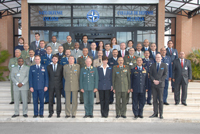
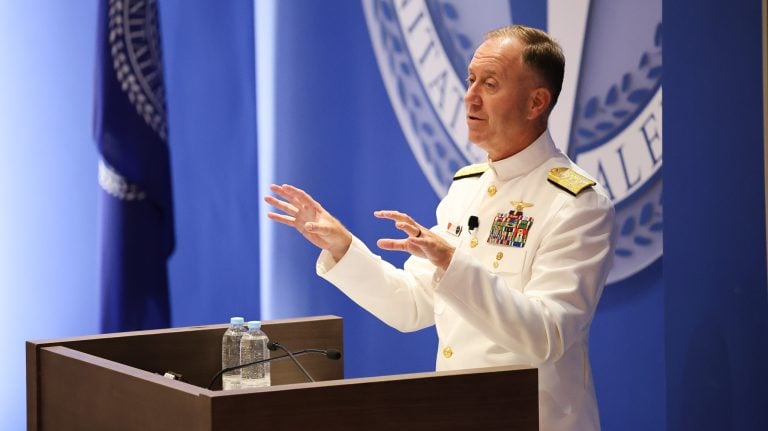
The seventh NRCC ten week course graduated today 11 May 2012 at the NATO Defense College in Rome, Italy, in the presence of H.E. Yasar YAKIS, former Minister of Foreign Affairs of the Republic of Türkiye and Vice Admiral Frank PANDOLFE, Commander US 6th Fleet and Commander Striking and Support Force NATO, as well as the Ambassadors to Italy from Jordan, Kuwait and Türkiye along with other distinguished dignitaries, who were warmly welcomed to the College by the NDC Commandant Lieutenant GENERAL Arne Bård DALHAUG and the Dean Dr. Richard D. HOOKER Jr.
The NRCC is an initiative developed in order to expand the NATO network of educational activities towards the partners of the Mediterranean Dialogue (MD) and the Istanbul Cooperation Initiative (ICI) and Contact and Partner Countries.
The purpose of the NRCC is to develop better mutual understanding of current and future security challenges affecting the region. This course also aims to foster respect and establish long term networking among participants.
The 7th NRCC course featured an expanded and enhanced curriculum which examined cultural understanding, NATO in transformation, international security organizations, regional challenges and security issues. The course culminated in a tough three-day crisis management exercise in which Course Members addressed a complex situation requiring a comprehensive approach.
NRCC 7th received a Keynote Speech delivered by H.E Yasar YAKIS, former Minister of Foreign Affairs of the Republic of Türkiye, who provided a sweeping overview of the developments surrounding the Arab Spring and an analysis of Türkiye’s potential to provide a model to manage change and transition. However, His Excellency stressed that this model must be tailored to each individual country and the context of each society. During the brief but intensive Q&A session, H.E responded to highly relevant questions with detailed expert opinions.
Vice Admiral PANDOLFE presented the Graduation Address focusing on the concept of educating and preparing future leaders who can work together across multiple cultural and national fault lines to address common challenges of the 21st century. He also stressed the need for leaders think broadly and critically about new approaches to challenges which are broader than military action alone.
At the end of their ten weeks at the NDC, the 25 participants from 13 Countries fully met the objectives of being better prepared for strategic challenges and for developing human interoperability through greater understanding, cooperation and trust.
NDC Public Affairs Office

 Collège de Défense de l'OTAN