
On November 2nd, Senior Course 121 (SC 121) was in Ottawa, where it received several interesting briefings form high-level Canadian representatives.
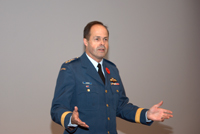
The Course was warmly welcomed by Gen Thomas Lawson, Chief of Defence Staff. In his opening remarks he underlined NATO’s historical and political importance for Canada, within a context of extensive Canadian engagement to international organizations and bilateral agreements. Canadian foreign policy, given the country’s geography, is the product of a constant effort to balance interests and efforts between the Atlantic and the Pacific, the East and the West. The need to secure so vast a territory has always made it important to ensure that Canadian forces have an expeditionary character: they are therefore able both to support internal security missions such as search and rescue operations, and to sustain a global military engagement.
Mr Chris Alexander, Parliamentary Secretary to the Ministry of Defence (MoD), was the first speaker of the day. He outlined the history of Canada, which has directly influenced its world view and international role. Since World War I, the country has been committed to firm partnerships, in which it has always taken on a strong and responsible role; among these, engagement towards NATO is fundamental. Canadian commitment to uphold its international obligations coupled with the need to compensate for a long period of low investments and to act on lessons learnt in Afghanistan, has prompted a return to more substantial investment in the defence sector.
The following speaker was Ms Jill Sinclair, Assistant Deputy Minister of Policy for the MoD, whose talk was entitled “The Canada Strategic Setting: Canada in the International Security Environment and NATO”. Ms Sinclair further expanded on the previous speaker’s argument that Canada has a global “vocation”. She underlined that Canada has a long record of serious international commitment, always seeking to act under UN mandates as a legitimate basis for missions; it has deployable and sustainable forces which can be used in such a setting.
BrigGen Chuck Lamarre of the Strategic Joint Staff provided Course Members with an overview of Canada’s forces and missions. He highlighted the extremely relevant role of public safety support and disaster response forces, as well as the importance of the country’s geographic position and of its special bi-national military cooperation with the United States. He also listed the many missions Canada is currently undertaking, largely represented by contributions to ISAF.
Mr David Beal of the Policy Planning Department, the last speaker of the morning session, briefed SC 121 on the subject of “Defence Strategy and Emerging Domains”. His presentation analyzed the process of developing and implementing the 2008 Canadian Defence Strategy, taking into account the considerable effect of new trends in the international strategic environment on Canada’s vision for the future. Factors to be acknowledged in this respect include events in the Arab World, demographic trends in Canada, environmental considerations and the current financial turmoil. Canada sees a number of specific areas on which defence reform should focus, among which Mr Beal mentioned the Command and Control reform as well as institutional alignment of the various departments concerned.
All four speakers left room for a detailed Q&A session after their briefings, and the interaction with Course Members was particularly rewarding. Among the areas that were further explored in the discussion were: the role of Canadian forces in public support, their budget priorities, Canada’s ambition (or lack of ambition) to become a bigger player in the international security setting, NATO’s possible role in the Arctic, Canada’s views on Afghanistan’s development, and the exchange of information on lessons learnt during disaster response operations with other partners like Japan.
SC 121 assembled once more in the afternoon to receive the final briefing and closing remarks. The last lecturer of the day was Ms Marie Gervais-Vidricaire, Director General of the Canadian Stabilization and Reconstruction Task Force (DFAIT). She argued with great conviction the Canadian view of international stabilization operations as part of a more general framework for broader international operations, depending on a strong contribution from diplomacy. As possible elements in a wide-ranging spectrum of operations, she mentioned the reform of the security sector, institution-building, and the protection of civil rights – both in general, and for women and children in particular. In order to make this holistic approach possible, the Canadian MoD’s engagement in missions is achieved through an integrated approach involving the Ministry of Foreign Affairs and, where possible, donors and development agencies.
After an extremely full and rewarding day of presentations and discussion, closing remarks and thanks for the visitors’ purposeful and informed participation were given by Mr. Artur Wilczynski, Director of General Security and Intelligence (DFAIT).
 Collège de Défense de l'OTAN
