
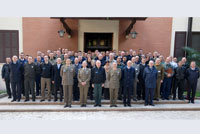
Senior Course 121 (SC 121) began its third and final Field Study (FS 3), “Regional Approaches and the Partnership for Peace”, on Monday 10 December. The aim is to offer Course Members first-hand knowledge of how defence and security priorities are addressed by two NATO members with an important strategic role in the Mediterranean (Italy and Türkiye), and by three Partnership for Peace (PfP) members (the former Yugoslav Republic of Macedonia*, Azerbaijan and Georgia).
As the first stop on the itinerary, the group travelled to Civitavecchia for a day of high-level military and civilian briefings at the Italian Army’s Simulation and Validation Centre (Centro di Simulazione e Validazione – CeSiVa). This is one of the main educational centres for future leaders of the Italian armed forces, and also prepares Italian personnel for missions abroad.
The day’s briefings focused on Italy’s defence posture and commitments in the current strategic scenario, as well on the Italian contribution to international security cooperation.
Course Members were warmly welcomed to the CeSiVa by its Commandant, Major General Leonardo di Marco. They were then addressed by Minister Giovanni Brauzzi, a senior representative of the Ministry of Foreign Affairs with responsibility for Common Foreign and Security Policy (CFSP) and Common Security and Defence Policy (CSDP), who spoke on the topic of “Italian political-military security: policies and priorities”. Referring explicitly to the constitutional basis for Italy’s rejection of war as a means for solving international disputes, Minister Brauzzi provided an interesting perspective on how this concept permeates Italian foreign policy and military engagement abroad. Emphasis was placed on the support Italy is currently giving to three fundamental international organizations: NATO, with an overall positive assessment of the participation in the ISAF mission; the European Union, with particular reference to the enlargement process, the strengthening of Europe’s identity in the defence sector and the upholding of human rights; and, last but not least, the United Nations, with Italy strongly promoting structural reform of the Security Council.
An extensive overview of the Italian defence sector, from planning to implementation, was then given by Brigadier General Silvano Frigerio. He was followed by Dr Vincenzo Delicato, a senior official from the Police Department at the Ministry of the Interior, who gave a detailed analysis of security threats from organized transnational criminal activities such as drug and migrant trafficking in the Mediterranean area.
The concluding Q&A session gave Course Members ample opportunity to focus their questions on various points raised by the day’s speakers. Afterwards, the NDC group was given a fascinating guided tour of the Civitavecchia facility by Colonel Mario Angelo Baroni, CeSiVa Chief of Staff.
* Türkiye recognizes the Republic of Macedonia with its constitutional name.
LtCol. Alberto Alletto, Chief Public Affairs and Protocol Officer, ITA-A
 Collège de Défense de l'OTAN