
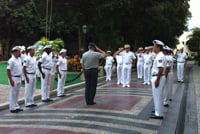
On 6 May 2013 a delegation from the NATO Defense College headed by Lt Gen Arne Bård Dalhaug, Royal Norwegian Army, Commandant of the NATO Defense College, visited the Brazilian Marine Corps Headquarters.
The visit was scheduled to coincide with the Europe Day Conference and High level Academic Roundtable of 8 and 9 May in Rio de Janeiro, on Brazil-NATO/European Union relations and outlook, for which the NDC was one of the promoters along with the Fundação Getulio Vargas (FVG) and the Konrad-Adenauer-Stiftung (KAS).
The NDC delegation was warmly welcomed by Fleet Admiral Fernando Antonio Siqueira Ribeiro, Commander of the Brazilian Marine Corps, who provided an exhaustive and in-depth briefing and presentation on the roles, missions, tasks, organization, recent operations and future developments of the Marine Corps, as well as on the Marine Corps Doctrine Development Command (MCDDC). This second briefing was provided by Capt. Guimarães, who proposed 9 points individuating same number of cooperation fields. Among them, future discussion on security and development strategies for South Atlantic and West Africa (Brazilian Marine role in Namibia, peacekeeping/peace support in Africa, Maritime Interdiction Operation – MIO -, antipiracy), exchange and debate on rapid response forces (scenarios and threats, capabilities and roles, the Brazilian Maritime vision) and courses conducted by the NATO Defense College and possibility for Brazilian Maritime Officers to attend a distance learning course.
Lt Gen Arne Bård Dalhaug, NDC Commandant, provided an overview to the Brazilian Marine Corps, of the NDC’s mission and educational activities and, during the meeting, which was also attended by Brig. Gen Desjardins, Director of Academic Operations Division and Dr Smith-Windsor from the NDC’s Research Division, both delegations shared experiences and areas of common interest, identifying future possibilities for cooperation.
The Marine Corps is part of the Brazilian Armed Forces with responsibilities in ensuring the security of the most important offshore and onshore areas of the country and in the planning of naval campaigns. The Marine Corps is a modern force, its size is consistent with available national funding and it is able to deter potential aggressors and thus work for the promotion of a peaceful settlement of disputes. In the recent past, the Marine Corps has been entrusted with United Nations Military Observer status, and has been posted to conflict and post-conflict areas such as El Salvador, Bosnia and Herzegovina, Honduras, Mozambique, Rwanda, Peru and Ecuador. In 1997 it was actively involved in the peace-keeping operation called United Nations Angola Verification Mission III (UNAVEM III).
NDC Public Affairs Office
 Collège de Défense de l'OTAN