
The Generals, Flag Officers and Ambassadors’ Course 2013-1 (GFOAC) took place at the NATO Defense College (NDC) from 6 to 10 May 2013. Entitled “Leading NATO into the Future”, the course was attended by a total of 49 ambassadors, generals, admirals, civilians and diplomats. Participants included representatives from NATO, the Partnership for Peace (PfP), the Mediterranean Dialogue (MD) and the Istanbul Cooperation Initiative (ICI), as well as Global Partners and the People’s Republic of China.
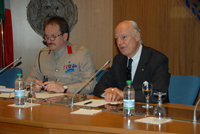
In his welcoming remarks on Monday morning, Brig. Gen. Gerd Bischof (DEU F), GFOAC Course Director and Director of Academic Plans and Policy at the NDC, highlighted both the Course’s objectives and the opportunities that it offers.
The opening lecture was provided by Prof. Christopher Coker (GBR), who offered a detailed and thought-provoking focus on “Cultural Dialogue: the Western Encounter with the Rest”.
“NATO after Chicago” was the topic of the afternoon lecture, delivered by Dr. Karl-Heinz Kamp (DEU), Director of the Research Division of the NDC. Dr. Kamp gave an excellent overview of the various challenges facing the Alliance in a post-Chicago perspective, setting the scene for a most interesting and comprehensive Q&A session.
On Tuesday 7 May GFOAC Course Members had the opportunity to enjoy two interesting lectures entitled “The Transatlantic Link: the Cornerstone of the Alliance”. The speakers were H.E. Mr. Robert E. Hunter (USA) and Prof. Carlo Masala (DEU), who briefed the audience on possible future challenges for the Alliance, highlighting that the Transatlantic Link is indispensable for both sides of the Atlantic. In the afternoon, there was a challenging lecture on “The Changing Character of Warfare”, by Thomas X. Hammes (USA).
On Wednesday 8 May, two vibrant and fundamental topics for the Alliance and its partners were addressed. In the morning, Prof. Fawaz A. Gerges (USA) and Prof. Mustapha Benchenane (FRA) spoke about “The Middle East and North Africa”. The focus then shifted to Afghanistan and Pakistan, with a lecture entitled “Strategic Crossroads – Afghanistan & Pakistan” by Dr. Samina Ahmed (PAK) and an early evening satellite videoconference with Gen. Joseph F. Dunford (USA) on “The Strategic Challenge of NATO’s Operation in Afghanistan”.
The programme for Thursday 8 May offered a fascinating combination of topics: “Technological Development: Risks and Opportunities”, addressed by Prof. Holger Mey (DEU), and “The Strategic Implications of China’s rise to Power”, on which Dr. James Boutilier (CAN) lectured in the afternoon.
On the last day of the course, the focus was on “Insurgencies and Small Wars” and “Opportunity from Crisis”, analysed by Dr. David Kilcullen (AUS) and Mr. Staffan de Mistura (ITA/SWE) respectively. The audience for the second of these presentations included Course Members from the NATO Regional Cooperation Course (NRCC), for whom this was the final lecture prior to their graduation ceremony.
In his closing remarks, Brig. Gen. Bischof summarized key messages from the week’s lectures and discussions, thanking participants for their active contribution to the interest generated by the GFOAC – a course which is proving exceptionally relevant to high-level participants from an ever-increasing number of countries.
NDC Public Affairs Office
(Prepared by Ms Francesca Blasi, ITA C)
 Collège de Défense de l'OTAN