
On Wednesday 18th December, SC 123 arrived in Podgorica, the capital of Montenegro, and the last stop on this interesting Field Study, before travelling back to Rome at the end of the week.
While en route to the hotel, the NDC delegation had the opportunity to briefly visit this historical city, located on the largest of the Montenegrin plains and situated on the confluence of three rivers: the Moraca, Ribnica and Zeta. Podgorica is also considered to be the oldest settlement in this part of the Balkans.
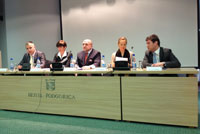
On Thursday 19th December, Mr Bojan Šarkić, State Secretary-Minister of Defence (MOD), welcomed the group and opened the session of briefings with a comprehensive presentation on his country’s defence policy. He stressed that, following independence, Montenegro had to deal with the need to organize its new armed forces. Mr Šarkić affirmed that: “The government was determined and lots of efforts have been done since that time.” He also stated that: “There are only 2 directions where Montenegro can go. One is the EU, the other one is NATO.” To achieve these goals, Montenegro is investing heavily in personnel and reforms, throughout all sectors of activity. The MOD State Secretary analysed unresolved issues in need of a solution to fully comply with NATO and EU standards. In view of the geostrategic importance of the country, he considers that NATO could well benefit from enlargement to Montenegro. Mr Šarkić also emphasized that the education of officers and officials is paramount to Montenegro. The MOD strongly supports the training of its officials abroad, in order to fully comprehend other countries’ mindset, and hopes that officers from Montenegro will be able to study at the NATO Defense College in the future. The support of Montenegro to ISAF was described in some detail and the speaker added that Montenegro was committed to the gender issue and to the implementation of UN Resolution 1325.
A lively Q&A session, which followed this briefing, highlighted defence-related budgetary and economic issues, as well as a number of other challenging topics. After the discussion, NDC Dean Dr Daria Daniels Škodnik and Mr Šarkić met to speak in greater detail about Montenegro’s interest in participating in NDC courses.
Mr Ivan Ivanišević, Director General for International Cooperation and European Integration from the Ministry of Interior Affairs (MIA), gave an overview of the measures adopted by Montenegro for improving the country’s administration and preparing state institutions for EU membership. Mr Ivanišević focused on the commitment to the strategic goals of full integration with NATO and the EU, independently of any possible changes in government. He also stressed the importance of communicating the concept of NATO integration to the public, given that Montenegro’s commitment in this respect is proving to be an effective mechanism for reform and for improving the quality of life of all citizens, through dynamic democratic and economic development.
Ms Ljiljana Janković, Head of the Directorate for NATO, analysed the expectations for the next NATO Summit. She also examined the initiatives Montenegro is taking to cooperate with international organizations, as well as bilaterally. The country is participating fully in a number of programmes aimed at developing the skills needed to pursue a broad international vocation.
This briefing was followed by another lively Q&A, moderated by Mr Saša Javanović, and ended with an exchange of gifts.
During the afternoon the NDC delegation moved on to Danilovgrad for a visit to the “Milovan Šaranović” barracks, to have a first-hand view of the improvements being made.
On Friday 20th December, SC 123 completed its challenging and extremely rewarding Field Study on “Regional Approaches & Partnership for Peace”, and the group now returns to Rome for the upcoming Christmas holidays.
This fascinating Field Study began with a visit to Slovenia and concluded with a visit to Montenegro. Interestingly, it should be noted that Slovenia fully supports Montenegro’s integration within NATO. More generally, finding out more about regional relations was one aspect of SC 123’s learning experience in the various countries visited: the opportunity to hear different points of view, on political and security issues which are relevant to NATO.
NDC Public Affairs Office

 Collège de Défense de l'OTAN