
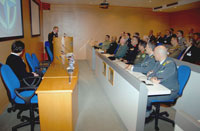
On 3rd March 2014, the Middle East Faculty (MEF) of the NATO Defense College inaugurated the eleventh NATO Regional Cooperation Course (NRCC 11). The opening ceremony took place in the Ismay Auditorium and was honoured by the visit of the Deputy Commander of Allied Joint Forces Command in Naples, LtGen J.H. Vance (CAN A). Participants were welcomed by the NDC Commandant LtGen Arne Bård Dalhaug (NOR A), the College Dean Dr Daria Daniels Skodnik (SVN C), and the Director of the MEF Col Giuseppe Morabito (ITA A).
The highlight of the ceremony was the lecture given by LtGen Vance. In 2009-2010, LtGen Vance was deployed as Commander Joint Task Force Afghanistan and Task Force Kandahar. Later, he served as Chief of Staff Land Strategy and as Director of Staff, Strategic Joint Staff at the National Defence Headquarters in Canada. In July 2013, he took up his duties as Deputy Commander of Allied JFC Naples. In his lecture, LtGen
Vance emphasized that the challenges posed by the multidimensional nature of 21st century conflict cannot be addressed by military force alone. The increasing prevalence of contingency operations, of which the ISAF mission is an example, indicates the need for NATO to be more oriented towards the Comprehensive Approach and dialogue building, which presupposes prior and ongoing commitment to solid partnerships. LtGen Vance underlined the importance of the NRCC in this respect: addressed to participants with very different backgrounds and perspectives, the Course offers a vital contribution in terms of mutual understanding, human interoperability and consensus. The lecture was followed by a stimulating Q&A session.
The NRCC brings together participants from NATO countries, from the Mediterranean Dialogue (MD) and the Istanbul Cooperation Initiative (ICI), as well as from Global Partners. Led by Faculty Advisers Col Dan Gillespie (USA F), Dr Jean-Loup Samaan (FRA C) AND Dr Andreas Jacobs (DEU C), the
eleventh edition of the 10-week Course includes 32 participants from 15 countries. The aims of the Course are to improve understanding of international, regional and collective security issues regarding the Middle Eastern region; to enhance knowledge of the historical and socio-political situation in the region; to develop Course Members’ abilities in strategic thinking and critical analysis; and to work towards mutual understanding on key political and military issues affecting the Middle Eastern region and NATO.
The NRCC thus comprises not only a comprehensive academic programme, but also a framework for dialogue and for diplomacy. Based on a combination of different teaching methods, the Course includes panels, debates, discussions, committee work, case studies and crisis-management exercises. Topics of major relevance are covered in a number of dedicated modules, including ‘Cultural and Political Challenges’, ‘NATO and International Organizations’, and ‘Global and Regional Security Challenges’. Another important part of the Course is a module on religion, exploring the interaction between religion, politics and security.
The academic content of the NRCC is complemented by Field Studies and other visits (SHAPE, NATO HQ, the Chamber of Deputies in Rome, Gricignano Naval Base and the Orientale University in Naples). There is also an extracurricular Art and Culture Programme, with visits to sites of particular historical and cultural interest in the Rome area.
In the five years since the inaugural edition of the Course in 2007, the NRCC has been successfully completed by over 300 participants, who are now part of the NRCC Anciens’ Association. Widely recognized as a unique educational contribution in the field of international relations, the NRCC model will hopefully be extended in the future to the study of other regions.
NDC Public Affairs Office

 Collège de Défense de l'OTAN


