
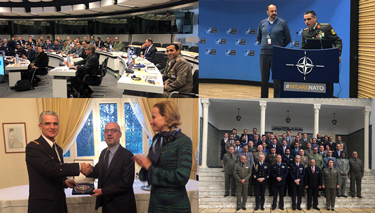
On 25 March 2019, the twenty-first NATO Regional Cooperation Course (NRCC-21) started its Field Study in Brussels, with visits to NATO Headquarters and the European Commission.
The purpose of the visit to NATO HQ was to engage with senior officials who are shaping not only the Alliance’s day-to-day activities, but also its overall strategic vision of cooperation and partnerships. MG Jan Toft (DAN A), Director of the IMS Cooperative Security Division, presented the Alliance’s main actions since the Wales Summit in adapting to new geopolitical realities. Explaining the principles adopted during the Wales Summit (‘more, better, quicker, smarter’), MG Toft reviewed progress in terms of burden sharing, projecting stability and cyber defence, as well as cooperation with international organizations. He also looked at ongoing development of partnerships, especially in Defence Capacity Building.
An exhaustive briefing on ongoing NATO operations was then given by Mr Mihai Carp, Deputy Head, IS Operations and Missions Section A, Operations Division. Mr Carp highlighted partner countries’ increasing participation in NATO operations and new opportunities to enhance practical cooperation, especially in the maritime domain.
The last briefing, by Dr Juliette Bird, Head Counter-Terrorism Section, Emerging Security Challenges Division, addressed the enhanced role of the Alliance in counter-terrorism. The Alliance’s efforts since 2002 were reviewed, highlighting its reinforced commitment.
All three lectures were followed by Q&A sessions.
The group then moved to the European Commission, where they met officials from the Commission and the EU Military Staff.
Col Siegfried Skudnigg (AUT A) of the EUMS spoke about the military dimension of the EU, illustrating CSDP milestones and the basic functioning of EU defence and security institutions. He underlined the importance of partners’ participation in EU missions and operations and dwelt on EU-NATO military relations, before focusing on the EUMS and the EEAS.
LtCol Antonio Mari Mateo (ESP A) provided an overview of EU missions and operations, highlighting the importance of the European contribution to the security of the MENA region and the African continent. Capt. Martinuzzi (ITA N) then illustrated the EUMS mechanisms for military assessment and planning.
Ms Aura Salla (FIN C), from the European Political Strategy Centre (a European Commission think tank), presented the European sovereignty concept and discussed the various features of Europe’s security and defence institutions, highlighting challenges to the development of European military capabilities and pointing out the various areas where NATO already supports the EU, notably with respect to the role of SHAPE in the absence of an EU Military C2 structure. Finally, Ms Isabelle Combes (FRA C) of the EEAS presented the various programmes and instruments of the European Neighbourhood Policy and examined challenges specific to the European assistance programmes for the MENA region.
Flying to Tunis on Tuesday 26 March for the second leg of the Field Study, NRCC-21 was received by Italian Ambassador H.E. Lorenzo Fanara, who currently represents NATO in Tunisia. At the Institut de Défense Nationale (National Defence Institute), Course Members learned about the multiple challenges faced by Tunisia since the Jasmine Revolution, the work of the IDN and the draft White Paper on Security and Defence. Ambassador Kais Darragi, Director of the Department of Economic and Cultural Diplomacy and Strategic Planning at the Tunisian MoFA, presented Tunisian foreign policy, highlighting the country’s mediation efforts on several regional issues (notably Libya) as well as the increasing contribution of Tunisian Armed Forces to UN and African missions.
During the afternoon, M. Brahim Nacef, Deputy Parliamentary President in charge of relations with the Government and the Presidency, reviewed and discussed the political and economic reforms undertaken since 2014. Finally, Col Mohsen Essefi (TUN F), a Senior Course Ancien, looked at the various challenges related to Tunisia’s security environment.
The Field Study was also an excellent opportunity for team building, networking and enjoy the company of NRCC21 fellows staff and course members.
NDC Public Affairs Office

 Collège de Défense de l'OTAN