
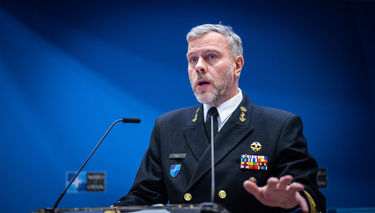
Admiral Rob Bauer, took command as the Chair of the NATO Military Committee (CMC) on 15 June 2021, becoming NATO’s most senior military officer and military advisor to the Secretary General and to the North Atlantic Council. In this capacity, he also presides the NATO Defense College’s Academic Advisory Board, which gives strategic advice to enhance the College’s operations and activities.
As Admiral Bauer’s tenure as NATO CMC draws to a close, with the change of command scheduled for this Friday, 17 January 2025, we had the privilege of speaking with him during his visit to the NDC for the 54th AAB meeting. This occasion provided a unique opportunity to reflect on his remarkable contributions and leadership throughout his service.
1) During your tenure as NATO Chair of the Military Committee, the Alliance has had to respond to an increasingly turbulent security landscape. How do you feel NATO’s strategic priorities have shifted since you started your tenure and what do you wish you had known then that you know now?
Over the past few years, the Alliance has entirely refocused on collective defence. NATO’s priorities are geared towards deterring and defending against two threats: Russia and terror groups.
The refocus on collective defence started long before Russia’s full-scale invasion in February 2022. After Russia’s illegal annexation of Crimea in 2014, the NATO Military Authorities initiated the biggest overhaul in defence planning since the end of the Cold War. This led to the creation of:
- The NATO Military Strategy (NMS) in 2019;
- The Concept for the Deterrence and Defence of the Euro-Atlantic Area (DDA) in 2020;
- The NATO Warfighting Capstone Concept (NWCC) in 2021.
It is because these strategies were in place, that NATO was able to respond as quickly and decisively as it did in February 2022. We have not only rapidly ramped up our posture and increased our deterrence. We have also made sure that NATO and national defence plans are now more closely integrated than ever before.
We have made immense strides. But we’re not there yet. In order to be successful, our new defence plans will have to go hand in hand with:
- bigger production capacity in our defense industries;
- more troops on high readiness;
- capacity building and development;
- adaptation of NATO’s command and control structures;
- creating and sustaining more enablement: logistics, Host Nation Support, maintenance and military mobility.
- and more collective defense exercises and training.
But above all, we need a whole of society approach to deterrence and defence. If there is one lesson we must all learn, it is that collective defence is truly a task for the collective. We need all parts of the government. And all parts of society, especially the private sector.
2) Your personal motto is “expect the unexpected”. Anticipating future challenges is central to NATO’s work, but so too is responding to current threats and challenges. How do you learn to expect the unexpected – to balance the need for long-term planning with the ability to react swiftly to emerging crisis?
Learning to expect the unexpected means that you stop thinking that tomorrow will look like today. And today will look like yesterday. You need to plan and prepare for different scenarios and then have the flexibility to adapt and improvise when those plans inevitably become outdated. Collective defence exercises can help with that, especially if they involve the private sector.
In addition, the public and the private sector need to make an analysis of where their dependencies lie. For instance, take their supply chain. Even when we are not directly involved in a war, we can already be faced with far-reaching effects. And also on the level of individual citizens, people need to ask themselves: what would I do if, for instance, there is no electricity for 72 hours? What luxuries am I taking for granted?
Expecting the unexpected means that you have to start seeing the world for what it is. Not for what you would like it to be. We have to combine hope and idealism with realism, always.
3) You have been quite vocal about your ambition to be a catalyst among NATO’s military leaders, and unifying north, south, east and west. With now 32 nations involved, aligning a unified military approach must be challenging. How have you fostered unity among NATO’s military leaders, especially during contentious times?
The position of Chair of the NATO Military Committee is about influence, not power. I certainly cannot force unity upon any of the 32-member nations. However, what I can do is help build trust within the Alliance. The best way to do that is by connecting with people on a personal level. Understanding what they are afraid of; and what they are proud of. Trust starts with understanding. And trust remains intact through honesty and transparency. The way people view me as a person will impact how they view NATO. So it’s immensely important to invest time and energy in personal relationships.
What I have found is that the solidarity among Allies is deeply felt. It’s real. We truly are a band of brothers and sisters.
Over the past years, I have tried to be a bridge builder. Not only among military leaders. But also at the political level, with the private sector, and with society as a whole. The reason I have done that is because collective defence is a task for the collective. We cannot be successful at it if we are all in our own silos.
4) At the NDC, we are dedicated to educating future leaders for Allied and partner nations, emphasizing strategic thinking to support effective, thoughtful decision-making. But being critical in a multinational context is not always easy. Could you describe a challenging leadership experience in your NATO career that tested your resilience, diplomacy and decision-making skills?
For those that know me, I can be quite Dutch. This means that I get straight to the point. And I can certainly be critical. If I am listening to a briefing and I feel that it doesn’t provide the requested information, I will say so. But I also always respect the effort people make. At the end of the day, we’re all working towards the same thing. So if I disagree with someone, I always try to see where they are coming from. Even big Alliances like NATO are built on personal relationships; that is the glue that holds us all together.
As Chair, it is my job to help enable consensus among Allies. That means you have to detect differences early on, and find solutions that make everybody happy. Or at least everybody evenly unhappy. This is a combination of patience and understanding on the one hand. And sometimes a little push is required.
In this position I have truly been myself. But I’ve also tried to adapt to the different roles that were required of me: whether it was diplomatic or political. I believe that my directness has been helpful in this time of growing uncertainty and high-pressure security developments. There is not a lot of time for beating around the bush.
5) Tackling current and future challenges is central to NATO’s work, which is also in line with the NATO Defense College slogan for this year: “forward thinking, future ready.” In terms of strategic vision, how does NATO balance the need for long-term planning with the ability to react swiftly to emerging crises?
As a result of the new strategies and defence plans NATO has put in place, we now know exactly how we will defend key and relevant places in our Alliance against the two threats described in the Strategic Concept and the NATO Military Strategy: Russia and terror groups. And we know precisely what assets or capabilities are required of us in a crisis scenario, including where and what to deploy, and what their tasks would be.
We are currently in the phase of establishing the Capability Targets. Which means that we determine per nation what capabilities they need to develop and expand. Not just in order to be able to execute our new defence plans. To be ready now. But we also need to make sure that we reach the long-term goals that are set in the NATO Defence Planning Process. To be ready in the future.
As a result of this, we will see a more even distribution of capabilities. European nations and Canada will develop capabilities that only the United States currently has.
This is a result of a process that has been going on for years, so it is independent from any national election. It is a system based on military logic, in order to have as much flexibility as possible.
6) A core element of our courses here is open dialogue among military officers and civilian officials from diverse backgrounds, including partner nations. Listening to and understanding different perspectives is essential to the collective defence process. Looking towards future threats and challenges, how do you envision future cooperation among NATO and its partners?
If there is one word that describes NATO in the past few years, it is the word “closer”. That is true for the cooperation among Allies. And the same goes for our cooperation with partners as well. Because when it comes to security, there is no such thing as local. Everything is connected to everything. Therefore, the best chance we have at staying safe is to cooperate and learn from partners as much as possible. It helps shed a new light on the challenges we face. And quite frankly, it prevents NATO from getting tunnel vision.
Cooperation with Partners is a two-way street. It is always based on and tailored to the requests of the partners. And it is always mutually beneficial. NATO brings together 3.5 million men and women in uniform coming from 32 different nations. When the Allied Chiefs of Defence gather for the NATO Military Committee, we have more than one thousand years of military experience around the table. The extensive and diverse knowledge we have can be beneficial to any likeminded partner. And if our partners are secure, then that adds to our security here in Europe and North America.
7) And lastly, can you share a decision during your term that you feel will have a lasting impact on NATO’s future and which you think deserves greater public attention?
As I said: this position is not about power. The Chair doesn’t take the decisions: the Allies do. But what I can influence is: what topics are put on the agenda and when. If there is one thing I have really pushed hard for, it is to make sure our military advice remained unfettered. We look at what is militarily the best option to keep our people safe. The military advice needs to remain just that: military advice. And then it’s up to the political level to take that advice forward.
What it all boils down to, is trust. And that is why the work of the NATO Defense College is so incredibly important. It contributes to the trust that is the glue that holds our Alliance and our partnerships together. If we trust each other, we can adapt to whatever comes our way. We can expect the unexpected, together. We can see together what we cannot see alone. We can do together what we cannot do alone.
NDC Public Affairs Office
(Prepared by Ms Sofia Carvalheiro, PRT C)
 Collège de Défense de l'OTAN