
Committee Study Project and Individual PaperCommittee Study Project and Individual Paper
The NATO Defense College Senior Course curriculum has two formally-assessed written requirements: a Committee Study Project (CSP) and an Individual Paper (IP). The CSP’s major learning objectives are to demonstrate the following: strategic thinking on a topic relevant to NATO; and consensus-building skills in answering a research question. The Individual Paper has similar objectives but provides Course Members the opportunity to express their individual research, analysis, and communication skills. The CSP/IP topics are derived from the NDC Research Division Annual Research Work Plan, which is approved annually by NATO’s Military Committee and noted by the North Atlantic Council.
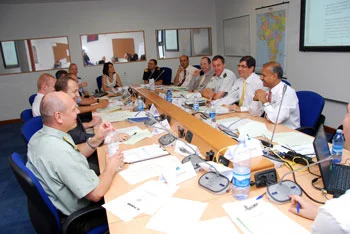
The CSP has emerged as the NATO Defense College Senior Course capstone project wherein Course Members demonstrate achievement of important curriculum objectives, by:
- Broadening knowledge and understanding of NATO;
- Improving strategic thinking skills;
- Fostering an open-minded attitude.
The CSP/IP process is designed as a lens for Course Members to observe and to reflect upon the content of each Study Period, Field Study and exercise throughout the entire course. The IP may be produced as a research paper or as a policy brief, and should be 2,400 words. The CSP results in two consensus-based products: an agreed paper between 2,500 and 3,000 words; and a formal presentation to the NDC Faculty, Course Members, and representatives from the NATO Headquarters and Strategic Commands.The highly-coveted Eisenhower Prize is awarded to the Committee with the best CSP. The best IPs from each Senior Course are announced at graduation and published on-line in The College Series. On a case-by-case basis, Course Member papers may be published by the NDC Research Division or in an external publication.
Senior Course 142
Defending the indefensible - Collective defence and deterrence in space
851.07 KB
By Ms Sarah CUNNINGHAM - SC 142
The College Series No. 40 - October 2023
...
What are the Implications of the Deepening Sino-Russian Partnership for NATO and How Should the Alliance Adapt to Address Them?
876.25 KB
By Mr Cameron GRAHAM - SC 142
The College Series No. 42 - October 2023
...
Strengthening NATO Members’ Supply Chain Resilience through Mutually Beneficial Partnerships with MENA Countries
964.15 KB
By Col Thomas NGUYEN - SC 142
The College Series No. 41 - October 2023
...
Senior Course 141
Building the Digital Warfighter - Is There Any Knowledge Missing?
1.46 MB
By CDR Pedro J RAMOS CARBONELL - SC 141
The College Series No. 35 - October 2023
...
Global Competition in North Africa and the Sahel: the Contribution of NATO Crisis Management to Deterrence and Defence
688.90 KB
By MAJ Daniele CAPURSO - SC 141
The College Series No. 39 - October 2023
...
NATO-EU Strategic Cooperation in Space - The final countdown?
1.01 MB
By LTC Rafael SANZ REBOLLO - SC 141
The College Series No. 38 - October 2023
...
Adaptation in the Age of Uncertainty
813.60 KB
By COL Geir Olav LYNGFJELL - SC 141
The College Series No. 37 - October 2023
...
The Economic and Financial Consequences of NATO’s New Force Posture
1.31 MB
By COL Tamas Szabolcs GASPAR - SC 141
The College Series No. 36 - October 2023
...
- 1
- 2
Senior Course 140
War on the mind: social media as a weapon
3.18 MB
By Mr Carsten PIETSCH - SC 140
The College Series No. 33/a - September 2022
...
Under the threshold threats in the space domain and NATO’s response
3.43 MB
By LTC Fergus PALMER - SC 140
The College Series No. 33/b - September 2022
...
‘Ware false messages from the East: untangling NATO’s role in cyber resilience
2.98 MB
By COL Alston OWEN - SC 140
The College Series No. 33/c - September 2022
...
AUKUS and NATO: liability or opportunity?
3.21 MB
By CDR Konstantinos MASOURAS - SC 140
The College Series No. 33/d - September 2022
...
China’s research on biotechnology and human enhancement: strategic implications for NATO?
2.93 MB
By BGEN Dr Almut NOLTE; BGEN Dr Almut NOLTE;
The College Series No. 33/e - September 2022
...
Senior Course 139
How are Emerging and Disruptive Technologies affecting NATO’s core tasks?
1.32 MB
By SC Committee 8 - SC 139
The College Series No. 33 - April 2022
...
Sino-Russian cooperation in developing Emerging and Disruptive Technologies (EDTs)
675.48 KB
By MAJ Tomasso GIORGINO - SC 139
The College Series No. 32 - April 2022
...
Energy security and collective defense: what is the impact on NATO cohesion? The Nord Stream case
1.30 MB
By Mr Göksel YAŞAR - SC 139
The College Series No. 31 - April 2022
...
NATO resilience – Lessons from small states
910.89 KB
By WG CDR J.P. DUNNE - SC 139
The College Series No. 29 - April 2022
...
Information warfare: Russia’s alternative, cheap solution to counter the conventional superiority of the West
691.31 KB
By LTC Sándor FARKAS - SC 139
The College Series No. 30 - April 2022
...
- 1
- 2
Senior Course 138
How are emerging and disruptive technologies affecting NATO’s core tasks?
800.41 KB
By SC Committee 7 - SC 138
The College Series No. 26 - December 2021
...
What potential does blockchain technology offer NATO?
1.42 MB
By LTC Stavros PSOFIDIS - SC 138
The College Series No. 25 - December 2021
...
China’s strategic interest in the Arctic and the opportunities it presents for NATO
764.30 KB
By COL Irinel APOSTOLESCU - SC 138
The College Series No. 24 - December 2021
...
Five interoperability challenges NATO must address to preserve its competitive military advantage
663.46 KB
By COL Emmanuel ANTOINE - SC 138
The College Series No. 23 - December 2021
...
NATO and non-state actors: a detached relationship. How to close the cooperation gap?
891.98 KB
By CDR Gianpaolo MISSERITTI - SC 138
The College Series No. 22 - December 2021
...
- 1
- 2
Senior Course 137
NATO and non-state actors: the future
821.88 KB
By SC Committee 7 - SC 137
The College Series No. 18 - May 2021
...
Securing the military advantage: NATO power projection in 2030
599.50 KB
By LTC Robert SCHOENEBERG - SC 137
The College Series No. 17 - May 2021
...
How will emerging technologies impact the skills required of military personnel and with what implications for future multi-domain operations?
621.10 KB
By COL Konuralp DURAGAN - SC 137
The College Series No. 16 - May 2021
...
China’s growing influence: what is NATO’s role in meeting the challenge?
907.57 KB
By LTC Marco MADILE - SC 137
The College Series No. 15 - May 2021
...
A revamped European pillar for a stronger NATO
624.62 KB
By COL Laurent FONTAINE - SC 137
The College Series No. 14 - May 2021
...
- 1
- 2
Senior Course 136
Increasing the cost for Russian hybrid activity: opportunities for NATO success
909.80 KB
By Mr Martin MOLLOY - SC 136
The College Series No. 12 - April 2021
...
Counter terrorism in counter hybrid warfare
682.01 KB
By CDR Niels MARKUSSEN - SC 136
The College Series No. 11 - April 2021
...
Solving the Russian puzzle - adapting NATO’s strategic warning capabilities to a new security landscape
683.63 KB
By Dir Henning Sveum KRISTENSEN - SC 136
The College Series No. 10 - April 2021
...
Russia’s modern warfare challenging the West: the Ukraine case study
849.12 KB
By COL Jarmo KESKINEN - SC 136
The College Series No. 9 - April 2021
...
Partnership: a source of cohesion through turbulent times
662.29 KB
By CDR Pål GUDBRANDSEN - SC 136
The College Series No. 8 - April 2021
...
Senior Course 135
Resilience in Finland: lessons for NATO
828.12 KB
By Col N.S.T. THEAKSTON - SC 135
The College Series No. 7 - September 2020
...
Arctic Centers of gravity
834.61 KB
By Cdr Michael GRAHAM - SC 135
The College Series No. 6 - September 2020
...
#WeAreNATO in the #MediterraneanDialogue
989.63 KB
By Mrs Nihal ERKAN - SC 135
The College Series No. 5 - September 2020
...
NATO Projecting Stability: rebranding or strategy?
1.37 MB
By Col Gert VAN GOETHEM - SC 135
The College Series No. 4 - September 2020
...
China in cyberspace: black swan to NATO’s black dragon?
1.35 MB
By Lt Col Gianmarco DI LORETO - SC 135
The College Series No. 3 - September 2020
...
- 1
- 2
 NATO Defense College