
For the Study Period on NATO in Transformation Part 1 (23 March-27 March), the members of Senior Course 114 were joined by the Integrated Partner Orientation Course (IPOC), comprising 17 participants from 13 countries, the Modular Short Course, consisting of 12 military and civilian participants from 10 NATO countries, and the NATO Regional Cooperation Course, consisting of 19 Course Members from 12 different countries. The main objective of this Study Period is to provide solid background knowledge of NATO and its development before the Spring Field Study, which will include visits to NATO Headquarters in Brussels, Allied Command Operations (ACO) in Mons, and Allied Command Transformation (ACT) in Norfolk.
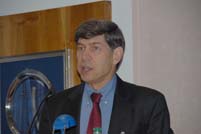
The first week of this Study Period began with the lecture by Mr Bruce BACH, Defence Policy and Planning Division, NATO HQ, on “NATO Defence Planning and Defence Structures”. In his presentation, which was an excellent scene-setter for the upcoming NATO Field Study, Mr Bach pointed out that defence planning is a vital function within the Alliance which keeps Allies focused through a common process used to address a number of challenges. He emphasized that the establishment of command structures, force planning and capabilities ultimately depend on the political will of the nations and the resources that they are willing to provide.
On the second day a panel lecture on the “The Transatlantic Link” was delivered by Ambassador Marc GELEYN from Belgium and Mr Stan SLOAN from the US. Both lecturers presented different perspectives on the topic and discussed possible new structures for cooperation between the Allies in the future. They provided updated information about recent developments on both sides of the Atlantic, such as the new US administration, the global financial crisis, and French re-integration into the NATO military structure, which could have an impact on future relations. The importance of NATO-EU cooperation was also brought up during the lectures.
Mr Joris GHESQUIERE, Head of Plans and Policy Branch at NATO Headquarters, gave an inspiring lecture on “NATO Resource Policy”, proving that the subject matter does not have to be dry and can be approached in a fresh and interesting way. He explained national, multinational, joint and common funding, how these and NATO’s infrastructure programs have strengthened the Alliance, and how NATO deals financially with its current challenges. He also provided a good deal of information on trust funds and outsourcing. He stressed that NATO common funding reinforces Alliance cohesion but it is not a magic solution that can overcome all the challenges faced in this respect.
A panel lecture on “NATO Transformation” was given by Rear Adm Jørgen BERGGRAV (NOR/N), SACT’s representative in Europe, and Dr Hennig Riecke , Head of the European Foreign and Security Policy Program at the German Council on Foreign relations. Rear Adm. Berggrav presented the basic visionary documents for NATO transformation, the guiding policy and conceptual documents, the relevant tools and the desired results of the transformation process. He stressed the need for NATO to acquire capable forces and appropriate capabilities. Dr Riecke provided a conceptual overview. He argued that NATO has always been an adaptable organization, and stressed that in the near future the Alliance will have some difficult decisions to make on a dapting the transformation agenda to operational demands.
The last lecture of the week, “The Strategic Challenges of Current NATO Operations”, was given by Major General Toon van Loon via VTC on Friday, 27 March. In an excellent lecture, Major General van Loon covered all aspects of the ISAF operation, displaying his breadth of knowledge and understanding of the region. He gave a perceptive analysis of the strategic military challenges facing ISAF today, and the political factors which impacted on the military effort. Drawing on his wide experience, he provided useful insights into the history, geography and socio-political structure of the country. In his personal thoughts on the comprehensive approach, he stressed that the real challenge in Afghanistan was building the country.
Overall, this was an extremely inspiring and stimulating week, full of challenging current topics and interesting discussions.
Prepared by Counsellor Kapucu (TUR)
 Collège de Défense de l'OTAN