
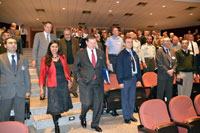
Following on from Module A of the academic curriculum which reviews the fundamental processes and conceptual issues which underlie the security environment in the 21st Century and discusses specific trends in the evolution of the security environment and their significance for NATO, Module B considers the international security framework within which NATO operates, through a discussion of the key international organizations and non-state actors.
Study Period B on International Organizations, run during the week from 14th – 18th March 2011, covered the key actors who play key roles both in the Euro-Atlantic Security Architecture and globally. Meeting today’s security challenges requires a wide spectrum of civil and military instruments, and close cooperation and coordination among a variety of actors. It requires a comprehensive approach by the international community. For that reason the Study Period focused not only on the two key international organizations in the Euro-Atlantic security community, the United Nations and the European Union (with the emphasis on the European Common Security and Defence Policy), but also on non-state actors such as Civil Society, Non-Governmental Organizations (NGOs), Multinational Corporations (MNCs) and Private Security Contractors (PSCs). These entities have evolved slowly, and there are still important questions to be answered in the quest for effective cooperation to deal with threats to our security.
It was only natural that the academic week should start with a lecture on the United Nations, which is the embodiment of cooperation among States to safeguard peace, the stronghold of shared values and commitments to security, freedom and prosperity for all, and whose aim is to prevent war among states and provide for order and justice – the list goes on. This lecture, the first in the Study Period, was delivered by Dr Mats Berdal, Professor of Security and Development at King’s College, London and Ms. Hannah DAVIES, a Programme Management Officer in the Office of the Under-Secretary-General, Department for Field Support (DFS) at the United Nations, currently on sabbatical leave. Among other topics, the lecturers focused on the issue of UN reform, the pros and cons of its existence, and its future prospects. Despite its imperfections and the frequent criticisms levelled at it, the UN is still the most important and most comprehensive International Organization and is clearly indispensable. Dr Berdal described the organization as a strange amalgam between idealism and realism that would surely have to be invented if it did not already exist.
Today’s European Union (EU), a supranational organization of 27 sovereign states across the European continent, stands as an unprecedented phenomenon in the annals of history. It is true that a zone of peace, in the Kantian sense, has been achieved among EU members since its establishment by the Treaty of Rome in 1957. But even as the EU grows in size and prosperity, there appears to be a limit to how closely Europeans want to embrace centralized European integration. Dr Peter Van Ham, Director of the Global Governance Research Program at the Clingendael Institute, explored the different aspects of the European Union – its past, its priorities and its prospects, as well as contemporary challenges.
The separate lecture on the European Union’s Defence and Security Policy (CSDP), as a major element of the Common Foreign and Security Policy pillar of the European Union, was delivered by Prof. Dr Julian Lindley-French, Eisenhower Professor of Defence Strategy at the Netherlands Defence Academy, Professor of Strategic Studies at Leiden University and Head, Commander’s Initiative Group (CIG), Allied Rapid Reaction Corps. He focused on the development of a Common Foreign and Security Policy (CFSP) and a Common Security and Defence Policy (CSDP) to deal with current realities and future challenges, the EU’s role in crisis management and the military component, and EU-NATO cooperation in the framework of a Comprehensive Approach.
The Study Period continued with a lecture on Civil Society and Non-Governmental Organizations (NGOs). Civil society and NGOs are playing an important part in the world, tackling issues that individual states alone either cannot address or choose to ignore. The increased role of civil society, civic groups and grassroots movements in drumming up support for alternative paradigms that are people-friendly and supportive of home-grown initiatives is reflected in the protests in the Middle East and North Africa. To introduce us to Civil Society and NGOs, we welcomed Dr Rama Mani, a Senior Research Associate at the University of Oxford’s Centre for International Studies, Mr Konstantinos Moschochoritis, General Director of Médecins Sans Frontières, Rome, and Dr Alain Deletroz, Vice-President (Europe) of the International Crisis Group. NGOs are characterized by their great diversity and are in fact a mass of different-sized organizations with different management structures and diverse missions. They now compete with states and international organizations and can have significant influence on those who actually formulate policy. But are they the first step towards an “international civil society”, or do they represent a dangerous shift of power towards unelected and unaccountable special-interest groups? How do they fit into NATO’s efforts for a Comprehensive Approach to crisis response operations? The panel succeeded in generating another thought-provoking academic day at the NATO Defense College.
Given the great importance of economic globalization and the role of Multinational Corporations (MNCs) and Private Security Contractors (PSCs) in it, it is crucial to evaluate their influence on security and stability and to discuss the significant ways in which these actors shape the zones of conflict. To discuss the topic, Ms Diana Klein, a Project Manager, Peace Building Issues Programme, International Alert, London, and Mr Rem Korteweg, Policy Analyst at The Hague Centre for Strategic Studies, joined Senior Course 117. During the Question and Answer session various aspects of the topic were discussed, ranging from the implications of enhanced international trade for the promotion of peace, to the implications of MNC and PSC involvement in conflict zones and their cooperation with other actors.
The key International Organizations were born in the aftermath of the Second World War and were all designed, in one way or another, to ensure that no global conflagration of this kind occurred again. During the past decade, the Euro-Atlantic security community has been adapting to cope with the challenges of the post-Cold War era. During this time, and particularly after September 11, it became increasingly necessary to confront issues that have both regional and global implications. As we are now facing complex threats that are sometimes inter-related, common efforts and common action against them are essential. The need for adaptation through reform is constant, a theme that Senior Course 118 discussed and developed successfully and with great interest.
NDC Public Affairs Office
 Collège de Défense de l'OTAN