
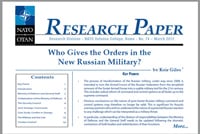
The ongoing transformation of the Russian armed forces has been subject to intense study both within Russia and abroad. But the focus has usually been on structural changes resulting from the ambition to create 21st century armed forces, or on ongoing procurement challenges. While command and control transition at a forces level has been well documented, change in command arrangements at the highest level has been relatively overlooked.
In this new paper by the Research Division, Keir Giles examines the evolution of the relationship between the Russian government and the military, and argues that the emergence of the Security Council of the Russian Federation as a key instrument of elite control now affects direction of the military as well. It is suggested that this constitutes the “civilian control” of Russia’s armed forces that has long been argued for – just not in a form that would be recognisable as the NATO ideal of democratic supervision.
More Research Division Publications…
NDC Public Affairs Office
 Collège de Défense de l'OTAN