
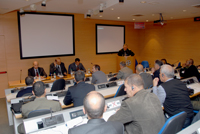
On 11th November 2013, the 10th NATO Regional Cooperation Course (NRCC 10) hosted three distinguished Egyptian speakers who analyzed, with NRCC Course Members, a wide range of security challenges currently facing Egypt.
Col Giuseppe Morabito (ITA A), Director of the Middle East Faculty, opened the first session of the day and introduced the speakers to the audience. After a warm welcome, the three speakers provided analyses of Egypt’s domestic security and stability, its diplomatic position on disarmament and the non-proliferation of weapons of mass destruction, and cooperation on security issues with NATO.
Gen Salah Aladdin Shahin Soliman, Assistant Director for Information Military Intelligence, gave a presentation on the domestic security situation in Egypt. His address started with a general overview, stressing the factors (e.g. violence, conflicts, terrorism, smuggling, illegal traffic, organized crime, and economic problems) that affect security and stability nationally, and have potential spill-over effects, regionally and internationally. He also briefly analyzed current conflicts in Libya, Syria and the Sudan, reviewed the Arab-Israeli conflict and, more generally, the Mediterranean and the Middle East region, emphasizing that Egypt is a key player in the area.
Ambassador Hossan Eldeen Aly, Director for Disarmament Affairs, Ministry of Foreign Affairs of Egypt, gave a speech mainly focused on disarmament and the non-proliferation of weapons of mass destruction (chemical and bacteriological). He provided a comprehensive overview of the international legal instruments developed by the international community under the auspices of the United Nations, to monitor and restrict the use of nuclear power. He also examined future developments for some Middle Eastern countries (in particular Egypt, Israel and Syria), on this important, but controversial, issue.
Minister Plenipotentiary Maled Mosleh, Deputy Chief of Mission (DCM) of the Arab Republic of Egypt in Brussels, mainly concentrated on cooperation in the field of security between Egypt and NATO. His address explored existing partnerships with NATO, such as the Mediterranean Dialogue, and cooperation agreements with the European Union. He also briefly referred to Egypt’s current challenges, including in the NATO context, but ended on a positive note by indicating that, despite political conditions in the Arab world, cooperation with NATO would improve.
These interesting presentations were followed by a truly lively Q&A, during which Course Members had the opportunity to discuss a number of security issues with the three speakers. These ranged from the security situation within Egypt, to future Egyptian elections following a referendum and the drafting of a new state constitution, to energy and water security, and finally, to the role of Egypt in the Arab-Israeli conflict and peace process.
NDC Public Affairs Office
(Prepared by Ms Monica Fornari, ITA C)

 Collège de Défense de l'OTAN