

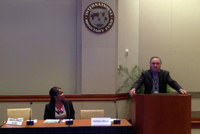
On 11 November, Senior Course 123 (SC 123) visited the International Monetary Fund (IMF) in Washington DC. During the visit (which was the first ever by a group from the NDC), Course Members were briefed by representatives of both the IMF and the World Bank (WB).
The NDC delegation was welcomed by Ms Anneta Orraca Tetthet, who works in the IMF’s Communication Department. Mr John Garrison of the WB’s Civil Society Team then presented the first briefing.
The speaker began with a historical overview of the WB, underlining the prioritization of monetary policy decisions at international level as an indispensable basis for economic growth. Governance is a significant dimension of IMF policy, with an emphasis on transparency and on ensuring that monetary policy takes into account major environmental factors such as natural disasters and climate change. Despite the problems, there is room for guarded optimism with regard to the role of global solidarity in reducing world poverty – the WB’s ultimate goal being to enhance shared prosperity. Broad participation through extensive relations with many countries worldwide is all-important in this respect, involving the WB in close collaboration with civil society and the private sector.
The representative of the IMF was Mr Patrick Cirillo, Principal Assistant to the IMF Secretary, who provided an overview of his organization’s mission and explained in what respects it differs from the WB. The overarching mission of the IMF, an international credit organization which was created in the wake of World War II, is to promote economic growth and stability. International monetary affairs, fiscal policies and finances are all of fundamental importance in achieving this goal, as is capacity building.
Given that the IMF was born as part of an effort to address economic inequities which emerged long before World War II, its work complements that of NATO: an essential priority of both organizations is to uphold the value of international peace, which necessarily implies not only a military dimension but above all a will to pool and share economic resources.
Course Members engaged both speakers in a fascinating and wide-ranging discussion.
This second day of institutional briefings in Washington DC marked the conclusion of SC 123’s visit to the US, impeccably hosted by the US Marine Corps. The NDC delegation is currently on its way to Belgium, where the Transatlantic Link Field Study will be completed by visits to Brussels (NATO Headquarters and the European Union) and Mons (Allied Command Operations, at SHAPE).
NDC Public Affairs Office


 Collège de Défense de l'OTAN