
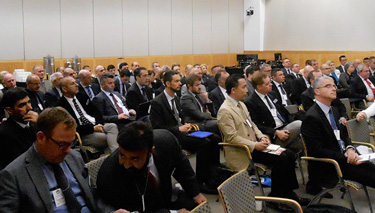
On 16 May, before leaving Washington, Senior Course 132 moved to the International Monetary Fund (IMF) Headquarters and had the opportunity to hear complementary briefings.
The first briefing of the morning at the IMF was given by a spokesperson from the Inter-American College in Washington: Dr Roberto Pereyra Bordón, Senior Professor & Faculty Coordinator, gave a presentation entitled “A perspective on Latin America”. He started his presentation by describing the security environment in Latin America, explaining that since 2003 it has become multidimensional. He gave Course Members different models to explain the relationship between defence and security in the various Central and South American countries. Dr Bordón commented on the situation in some countries like Venezuela and Brazil. He also spent some time discussing Colombia and the challenges the country is facing following the agreement between the Government and the FARC. He then explained the different security challenges in the region, before ending his presentation by examining the intercontinental relations of Latin America and the role of China, of the BRICS countries and, in Nicaragua, of Iran.
Following the presentation about South America, there were talks about the so-called Bretton Woods institutions. Mr Herbert F. Curry Arceo, Senior Consultant at the World Bank, took the floor first to illustrate the role of the World Bank, describing the evolution of the organization over the last sixty years and giving details on how it works with governments (financing projects, for example) or with the private sector (helping to establish companies in Africa, for example). He explained loan arrangements to support country development, showed how the members of the World Bank work together through the Board of Governors to achieve the organization’s ‘twin goals’: to end extreme poverty and boost shared prosperity by 2030. In particular, World Bank efforts are concentrated in sub-Saharan Africa and South Asia. Development support projects of the World Bank are not only related to poverty, but cover development domains like early childhood, climate or gender equality.
The last briefing was by Mr Patrick Cirillo, Principal Assistant to the Secretary of the International Monetary Fund (IMF). He focused on the IMF, explaining its origins and what it is today. He described the organization’s different roles: surveillance of the global economy and intervention to stabilize it if necessary, lending money where immediately necessary and in certain conditions, and supporting capacity development. These roles were likened to being a “doctor”, a “firefighter” and a “teacher” for the global economy, by working in close cooperation with other organizations. IMF resources come from the Members as “membership quotas”, determined by their ranking in the global economy. In the speaker’s opinion, there is some good news: the global economy has gained in stability, but there are some short-term risks and structural challenges – for example, inequality between countries and rising sovereign and corporate debt.
This second day of the visit to Washington was again a success, helping Course Members to better understand the diplomatic and economic environment around defence activities, and giving them an overview of the Bretton Woods system and its organizations which contribute to global security.
NDC Public Affairs Office

 Collège de Défense de l'OTAN