
On 7th December 2012, the NATO Defense College (NDC) celebrated the graduation of the eighth NATO Regional Cooperation Course (NRCC 8). Invited guests were saluted on arrival by a Carabinieri Corps Guard of Honour, and warmly welcomed by NDC Commandant Lieutenant General Arne Bård Dalhaug.
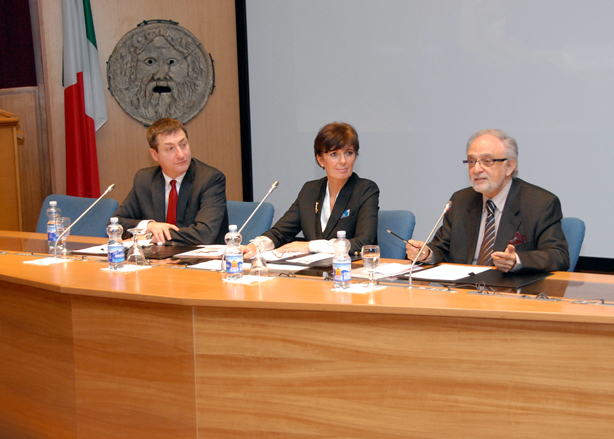
Just before the graduation ceremony, distinguished guests joined Course Members from both NRCC 8 and Senior Course 121 (SC 121) in the Maynard-Thorn Auditorium, for a panel lecture entitled “Israel and the Palestinians”. Speakers Prof. Yossi Mekelberg (GBR/ISR) and Dr Ibrahim Souss (FRA) provided an extremely authoritative, balanced analysis of pivotal issues and prospects for their successful management, from an Israeli and a Palestinian viewpoint respectively. The ensuing Q&A session afforded a rare opportunity for discussion of very different experiences and perspectives, in a spirit of reasoned dialogue far more meaningful and encouraging than any token exchange of diplomatic niceties.
In his end-of-course keynote address, LtGen Dalhaug spoke not only of the NRCC as a fundamental part of the NDC’s mission, but also of its significant contribution to the professional development of Course Members in high-level civilian and military office, increasingly called on to address defence- and security-related questions relevant to the international community at large.
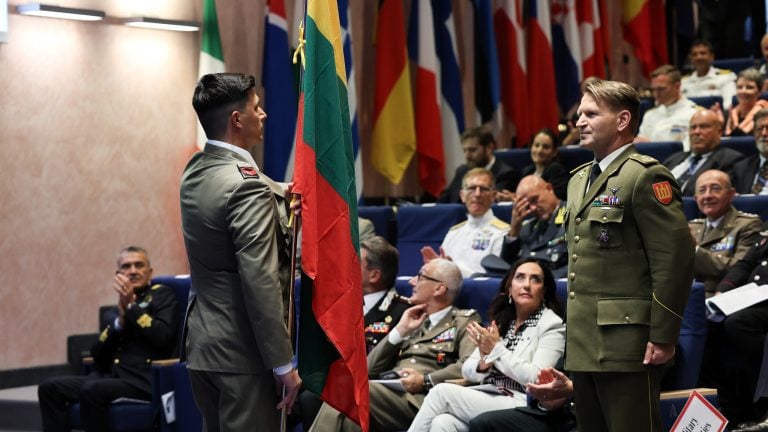
Following LtGen Dalhaug’s address, NRCC 8 Course Members came forward individually to receive their graduation diplomas and the personal congratulations of the NDC leadership.
As an enlargement of the Alliance’s educational activities to include the Mediterranean Dialogue (MD) and the Istanbul Cooperation Initiative (ICI), as well as NATO’s partners across the globe, the NRCC was developed with the purpose of enhancing dialogue, reciprocal understanding and cooperation in facing current and emerging security challenges for the Middle East and neighbouring areas.
NRCC 8 brought together 38 military and civilian leaders from 17 different countries including, for the first time, the Netherlands and the Sultanate of Oman. The curriculum was at once broad and focused, embracing a number of significant strategic challenges and the resulting need for informed planning at the regional and global level. Educational activities were not limited to the classroom: as has become traditional at the NRCC, the syllabus included lectures by authoritative representatives of different faiths, as well as visits to their places of worship. Far from offering a mere complement to mainstream security-related topics, such activities enable Course Members to work towards a truly comprehensive strategic dialogue and to develop what the College calls “human interoperability”, establishing mutual trust as a firm basis for cooperation.
NDC Public Affairs Office
(Prepared by Ms Eleonora Fuser, ITA C)

 Collège de Défense de l'OTAN