

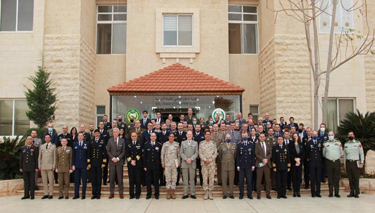
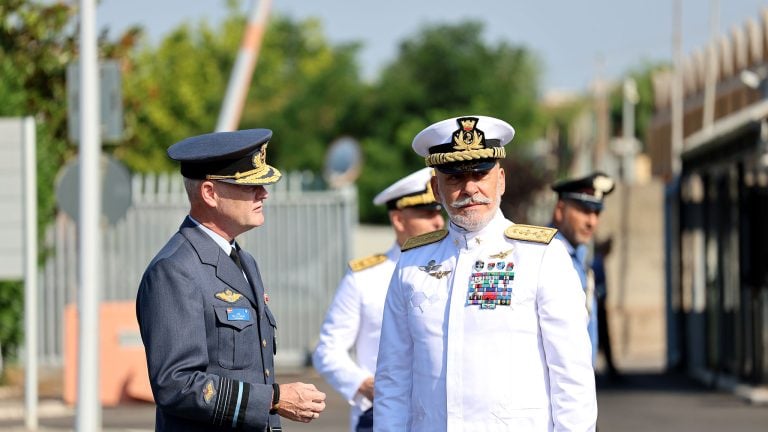
The first leg of Field Study (FS3) for Senior Course 139 began on Monday 6 December with travel to Amman, capital city of Jordan, joined by Faculty, Staff and Leadership representatives of the NATO Defense College (NDC). The group was received at the Royal Jordanian National Defence College (RJNDC), where its Commandant, Brigadier General Dr Awad Al-Tarawneh welcomed NDC Commandant Lieutenant General Olivier Rittimann with an honour guard.
Director of Military Intelligence Brigadier General Azzam AL-RAWAHNEH provided a briefing, illustrating the challenges and threats at the Jordan’s national and regional levels. He provided a brief overview of the last twenty years and how the country is at the center of persistent instability in the neighboring region. Defined as a frontline for international security and a cornerstone of stability in the broader Middle East, amid conflicts and crises that surround the Jordanian region, the Director also addressed the situation in Syria, Iraq, Palestine and the MEPP. He gave Course Members insight on the internal challenges at the domestic level regarding smuggling, drug trafficking, cross border flows terrorism, immigration, and the impact of COVID-19 both at the domestic level and its impact on regional security.
The second briefing was delivered by H.E the Minister of Interior, Mazin Abdellah Hillal Al Farrayeh who provided an extensive overview of the national security situation, highlighting the strategy and goals of his Ministry.
Minister Al Farrayeh presented the organizational structure of the Ministry of Interior, which is one of the primary Jordanian entities responsible for, inter alia, for all internal disputes, public safety and refugees. The Jordanian territory is divided in 12 governorates, each accountable to the Ministry of Interior. Such political decentralization is also reflected in the Jordanian House of Representatives.
Minister Al Farrayeh explained how Jordan is considered as a “country of safety and security” because of its stable political leadership and security agencies, which simultaneously must manage the ongoing issue of migrants. A tolerant country which endeavors to counter drug trafficking and abuse through intelligence and police patrolling on the ground, and is increasingly sensitive to freedom of expression and freedom of the press.
Senior Course 139 received the third briefing from the speaker of the Lower House of Representatives of Jordan, Abdul Karim Al-Doghmi who described the role of the Parliament under the constitution of the Hashemite Kingdom of Jordan, was adopted in 1952. The constitution assigns legislative authority to the parliament and to the King, in whom sole executive power is vested.
The visit at the RJNDC concluded with the final briefing by Ambassador Fyez Khouri Head of European Department at the Ministry of Foreign Affairs. He highlighted the regional and international strategies to achieve the national and regional objectives, and spoke of the country’s foreign policy posture.
Ambassador Khouri described how moderation and dialogue in solving disputes are among the main traits of the Jordanian government. Jordan is a country that pays respect to other religions and cultures and that enjoys local and international trust.
Each session was followed by an engaging Q&A session through which the Course Members benefited from deeper insights from the Jordanian representatives.
The Jordanian leg of Field Study 3 concluded the following morning with a cultural tour of the Old City of Amman and the Roman theater.
NDC Public Affairs Office
(Prepared by Ms Ilaria Latorre, ITA C)
 Collège de Défense de l'OTAN