
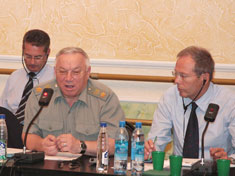
Nato Defense College visited Moscow with the Senior Course (SC) 114, 13-16 June, organized and hosted by Center for Political and International Studies (CPIS), a non-governmental independent non-profit research and consulting institution established in 1989. Dr. Alexander I. Nikitin, the Director of CPIS, had set up a very interesting academic and cultural programme for the SC.
It is to be noted that this is the only Capital NDC is visiting without formally being invited and hosted by the Government.
First briefing “Modern Russian Military Doctrine and Reform of Russian Military” by Col Sergei Cheninov, Chief of the Centre for Military-Strategic Studies under the General Staff of the Russian Armed Forces. Then Mr. Yury Gorlatch, Deputy Director, Department of European Cooperation, Ministry of Foreign Affairs, briefed on “Modern Priorities of the Russian Foreign Policy and Russia’s Initiatives on Elaboration and Conclusions of the European Security Treaty”. The next briefing was “Collective Security Treaty Organization (CSTO): Creating New Collective Forces for Operational Reaction and Other Trends in Military-Political Integration among the New Independent States” by Col.Gen. Valery Semerukov, Deputy Secretary General, Collective Security Treaty Organization.
In addition the following briefed: Dr Victor Kamyshanov, President of the International Federation for Peace and Conciliation. Dr Tatiana Parkhaklina, Director of the Centre for European Security and finally Anatoly Kulikov, Army General, Anti terrorism Advisor to Interior Minister.
We were positively surprised by the frank and open presentations and discussions this year.We also met a panel with different views in one Q & A period and this was refreshing after a long day with briefings.
The Medvedev “European Security Treaty” (EST) initiative was explained as improved relations through a pan European Security Organization. Countries should not have different level of national security (i.e. NATO Art 5). The basic principles of security (EST) are:
-parties to the conflict should not use force (i.e. find bilateral agreement),
-parity in security should bring down military capability,
-comply with existing mechanisms (e.g. CFE, Open Sky),
-rights of minorities should not be in this Treaty.
The goal is to make Europe more secure, and RUS is open to dialogue on how to achieve this, but is willing to use time (long) on development of EST. Medvedev’s EST does not compete with OSCE. Conflict resolution and arms control in one organization are contradictory.
Also the war in Georgia, Iran, North Korea, terrorism and energy was presented and discussed without any new development. It is still obvious that RUS and NATO do not have the same views in all cases, but in some areas like terrorism, Afghanistan, proliferation and others both parties have an interest in cooperation.
NDC SC visits Moscow to learn and is grateful for the presentations and answers given since it helps develop the common understanding of what we have in common and were we have different interests or views. With so little military to military contact between RUS and NATO, the academic contact this visit represents helps remove misunderstandings and misconceptions. NDC is looking forward to the next Russian student attending the Senior Course since this could increase the understanding of each others views.
The optional cultural program organized by “Center for Political and International Studies” included Russian Circus, visit to Kremlin including the museum, sightseeing in Moscow ending with a cruise on the river. The organizational part of the visit; from entry into Russia till departure was impeccable thanks to the great effort of Dr. Nikitin.
Overall the visit to Moscow was a success and NDC hopes that one day we will visit as formal guests of the Russian Government.
Prepared by Captain Harald Hakonsen, NOR N

 Collège de Défense de l'OTAN