

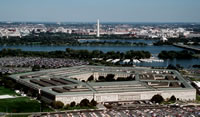
On Thursday 8 May and Friday 9 May, Senior Course 124 was in Washington DC. The programme for Thursday comprised a visit to Capitol Hill in the morning, and to the Pentagon in the afternoon.
In the Russell Senate Office Building, the delegation was welcomed by Brigadier General David Furness, Legislative Assistant to the Commandant of the Marine Corps. In his introductory briefing, he described the interaction between the defence structure at Capitol Hill and the political legislative branch. An important factor in this respect is the process of creating “shared understanding” between the representatives of the Armed Forces and the Armed Services Committee of both the Senate and the House of Representatives.
The second speaker was Mr Jeff Dressler, a Professional Staff Member at the US House of Representatives, where he serves on the Foreign Affairs Committee. He updated Course Members on current political debates related to US foreign relations, especially with regard to recent developments in Ukraine and Afghanistan. He also described the domestic political discussions on implementation of the F-35 fighter aircraft project.
Mr Kenneth Kato, Associate House Historian, offered a fascinating overview of congressional foreign policy from a historical perspective.
During the course of the morning, Dr Daria Daniels Skodnik (SVN C), NDC Dean, had the opportunity to speak with Brigadier General Thomas A. Gorry, Commandant of the Dwight D. Eisenhower School for National Security and Resource Strategy at the National Defense University. They discussed the respective institutional missions of the NDC and the Eisenhower School, as well as possibilities of cooperation between the two.
At the Pentagon in the afternoon, Mr James Townsend, Deputy Assistant Secretary of Defense for European and NATO Policy, spoke about the evolution of NATO strategy over the last two decades, and about current US security policy regarding the future of the Alliance. He also offered informed insight regarding the possible agenda of the upcoming NATO Summit in Wales, later this year.
The next speaker was Brigadier General Jacqueline Van Ovost, Deputy Director for Politico-Military Affairs from the Strategic Plans and Policy Directorate of the Joint Staff. After explaining the structure of the US National Security Council and briefly reviewing global security trends, she presented US-NATO opportunities for capability development in a number of fields.
The last presentation at the Pentagon was by Vice Admiral Kurt W. Tidd, Assistant to the Chairman of the Joint Chiefs of Staff. This was undoubtedly a major highlight of the Transatlantic Link Field Study. The speaker looked back at significant events which have shaped US security policy in the early 21st century, before examining current and emerging security challenges such as proliferation. Finally, he dwelt on the impact of fiscal constraints. The most valuable part of this briefing was a survey of challenges for US commanders, balancing shrinking forces with the growing demand for new capabilities.
Each of the briefings at the Senate Building and Pentagon was well complemented by a lively question and answer session.
On Thursday evening, SC 124 was hosted at the US Marine Corps Barracks. During the course of the evening, warm thanks were expressed by the NDC Dean to the Chairman of the Joint Chiefs of Staff and the Commandant of the Marine Corps, represented by Lieutenant General Kenneth J. Glueck Jr, for the valued support given by the Marine Corps to NDC groups visiting the US during Field Studies.
On Friday, the group visited the National Defense University (NDU). Here, the programme began with a welcome address by Ambassador Wesbitt, Deputy Chair of the NDU Board. This was followed by a panel, with the participation of three highly qualified researchers from the NDU Institute for National Strategic Studies: Mr Leo G. Michel spoke about US perspectives on the Russia-Ukraine crisis; Dr Steven Kramer gave a historical overview of European security; and Dr Christopher Yung explained the US “pivot” to the Asia-Pacific region.
The next briefing was provided by John W. Garrison, from the Civil Society Team of the World Bank (WB). After a historical overview of the WB, the speaker dwelt on the organization’s two main goals: reducing the level of extreme poverty in the world to less than 3% by 2030; and ensuring shared prosperity for the bottom 40% of the population in every country.
Mr Patrick Cirillo, Principal Assistant to the Secretary of the International Monetary Fund (IMF), then gave an excellent lecture on the goals of the IMF. The organization’s overarching mission is the promotion of international economic growth and stability. International monetary affairs, fiscal policies and finance are all of fundamental importance in achieving this goal, as is capacity building. At the end of the presentation, the speaker focused on current economic challenges worldwide and offered a wide-ranging perspective on appropriate strategies.
The last lecture of the day was by Mr Rick Holtzappe, from the Department of European Affairs of the US State Department. He appraised the significance of US policy towards European countries and towards NATO, as an organization. He also focused on consequences of the ongoing Ukraine crisis.
Course Members had ample opportunity to engage all the day’s speakers in detailed discussion of their respective subjects.
The last event on the programme for the visit to Washington DC was a spectacular evening parade of the US Marine Corps, in the historic barracks at 8th and I.
After two very full and rewarding days in the US capital, the NDC delegation is currently visiting NATO Allied Command Transformation in Norfolk, VA.
NDC Public Affairs Office

 Collège de Défense de l'OTAN


