

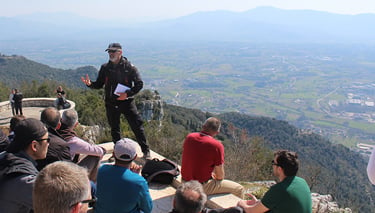
On 21, 22 and 23 March 2022, Senior Course 140 took part in an NDC Staff Ride within Field Study 1, which included a Study Day, a Briefing Day and a day in the Field in Montecassino.
The Senior Course embarked on the third iteration of the Staff Ride to enhance their understanding of the complexity of multinational/coalition/allied operations. This time, the activities were conducted within the framework of the Field Study Programme.
The focus of the study was once again, the Italian campaign of 1943/44, and how to manoeuvre around the extraordinarily dramatic and significant terrain around the ancient Abbey of Monte Cassino. Seventy-eight years ago, it formed a key part of the infamous ‘Gustav Line’ which was well-designed, well-defended and successfully delayed the Allied advance to Rome, offering numerous lessons to learn of both value and relevance to senior leaders in the modern NATO Alliance. Today, the site is UNESCO protected.
The third edition of the NDC Staff Ride has followed a particular model which consists of two days at NDC and one day in the field.
The first day was dedicated to briefings by Subject Matter Experts (SMEs) on the overarching strategic context (and implications of strategy for NATO), the operations (from both sides’ point of view), and the participation of specific contingents (France, the United States, Poland). The SMEs were Dr Rob Johnson, Director of the Changing Character of War (CCW) Research Centre at Oxford University; Professor Niall Barr, professor of Military History and Dean of Academic Studies (Head of Department) of the Defence Studies Department of the King’s College London; Dr Magnus Pahl, from the Bundeswehr (German Army) Museum of Military History and Lieutenant Colonel (Ret.) Christophe Gué.
The second day was divided into 2 parts. In the morning, committee groups prepared short presentations of ten minutes on a pre-determined theme, such as commanders, the Allied logistics, and information operations. In the afternoon, each committee presented their analyses. Each committee was guided by a SME and supported by the senior mentor, to offer advice and support in framing, content, and delivery.
That evening, the entire course moved to the Monte Cassino area, and visited a Commonwealth War Graves Commission cemetery where the ‘‘soldiers’ experience’’ was the focus of a final presentation, accompanied by a wreath laying ceremony.
The final full day was devoted to a tour of four stands at which SMEs delivered explanatory details of the strategic, operational and tactical events, each drawing out the lessons and implications applicable to modern NATO officers. These included generalship, command, staff work, communications, operational art, manoeuvre, terrain, friction, morale, and inter-Allied cooperation.
The stops included the village of San Pietro Infine, St Angelo in Theodice, Point 593, the Polish Cemetery and the Abbey of Monte Cassino.
As a case study of campaign, it is rich with lessons and details often overlooked in a pure reading of NATO doctrine. Moreover, unlike the study of maps or histories of the campaign, the opportunity to see the topography and study in situ brought the lessons to life.
Course Members offered positive individual feedback, as both as an experience and a method of learning. They highlighted how interesting it was to see all the elements of campaigning and joint operations brought together to form a ‘bottom up’ understanding of strategy. It allowed strategic options to be discussed, debated, reflected upon,and it brought to life the frictions and challenges of operations, allowing comparative analysis to be carried out.
The Staff Ride also widened the repertoire of experience of CMs in a stimulating and dynamic manner, whilst simultaneously providing a welcome opportunity for cohesion-building within committees and across the SC 140.
NDC Public Affairs Office
 Collège de Défense de l'OTAN