
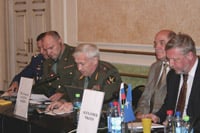
On the fourth leg of their Summer Field Study, Senior Course 116 visited Moscow (Russian Federation). They were welcomed by Prof. Alexander Nikitin, Director of the Centre for Political and International Studies, who outlined the programme for the day and gave a thorough introduction to Russia’s view of its security situation. Among the topics he examined were NATO-Russia relations, the security structures including Russia as a member, the Medvedev proposals for new security architecture, and Russia’s security concerns.
Prof. Nikitin was followed by Dr Igor Yurgens, Chairman of the Board of the Institute for Contemporary Development, who delivered a lecture on “NATO-Russia Relations in the Modern Political and International Context”. He analysed in detail the historical developments since 1954 that have affected relations between NATO and Russia, and offered ideas for broad-based future cooperation in areas such as energy, materiel and operations. He announced that a Russian paper was to be published in answer to the paper produced by the “group of wise men”. In the discussion period following his lecture, Dr Yurgens gave frank answers to a wide range of questions.
After the coffee break, the next speaker was Lt Gen Evgeny Derbin, Chief of State Governance of the National Security Department of the General Staff Academy, who explained the new Russian Military Doctrine, from general principles to more detailed goals. He touched upon anti-ballistic missile defence, enlargement and US policy. During the Q&A session, he reflected on the Black Sea area and Russia-NATO relations, among other issues.
The last speaker in the morning session was Mr Yuri Gorlach, Deputy Director of the Department of European Cooperation (Ministry of Foreign Affairs), who examined “Modern Priorities of Russian Foreign Policy”. He stressed commonalities in approach, and gave the Russian view on the NATO-Russia Council. In the discussion period that followed, he answered questions on a wide range of subjects including Afghanistan, NATO-Russia cooperation and anti-ballistic missile defence.
After lunch, course members heard the views of a delegation of the Collective Security Treaty Organization (CSTO), led by Mr Anatoly Sagakyants, Head of the Military Security Department of the International Secretariat of the CSTO, who spoke on “Modern Priorities and Activities of the CSTO as a Multi-profile Regional Security Organization of a New Type”. Mr Sagakyants gave details of the member countries, several articles of the treaty and the organizational structure of the CSTO. He also explained the main areas of cooperation: economic, military and fighting illegal drug trafficking and illegal immigration. In the Q&A session most questions were aimed at getting more clarity on thoughts on future CSTO expansion and NATO-CSTO cooperation, as well as the way the CSTO operates.
Mr Sagakyants was followed by the Director of the Centre for European Security, Dr Tatiana Parkhaklina, whose frank presentation, “Views of Civil Society on Russian Foreign and Security Policy”, examined the reset of NATO-Russia relations, the Russian perspective on NATO enlargement, the positioning of ballistic missile defence systems on the soil of NATO nations and the arms control situation in Europe. Dr Parkhaklina, who described the Medvedev proposals as a Russian initiative to start new negotiations, explained the pros and cons of Russian membership of NATO. She was followed by Dr Victor Kamyshanov, President of the International Federation for Peace and Conciliation, who extensively explained his organization and elaborated on the international security system.
The last speaker was General Anatoly Kulikov, MP and Chairman of the International Anti-criminal Anti-terrorist Forum, who dealt with “Legal Grounds for Russia’s Policy of Combat against Terrorism”. He explored Russia’s history of problems with terrorism, and the structures, procedures and laws that Russia has put in place in order to cope with the phenomenon. Related social issues seen as causes of terrorism were addressed, in addition to the role of the armed forces in fighting terrorism inside and outside the Russian Federation. In the discussion period, course members were mostly interested to hear General Kulikov’s views on the links between terrorism and international crime, on international terrorism in general, and how the military were trained to combat terrorism.
After an intensive day, Senior Course 116 left the conference centre with a deeper knowledge of Russia and Russian views on related security issues.
More about SC116 Summer Field Study:
First day – Italy
Second stop – London
Third step – The Hague
NDC Public Affairs Office

 Collège de Défense de l'OTAN