

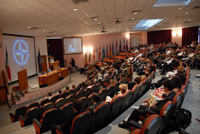
Lt Gen Wolf-Dieter LOESER, Commandant of the NATO Defense College, today welcomed new Course Members for the official start of Senior Course 118. With 85 participants, this first course of the year gives us a chance to welcome a group in which 32 countries are well represented. A significant number of participants have joined the Course from the Partnership for Peace Programme, the Mediterranean Dialogue, the Istanbul Cooperation Initiative and Contact Countries, and there are two Course Members from Iraq.
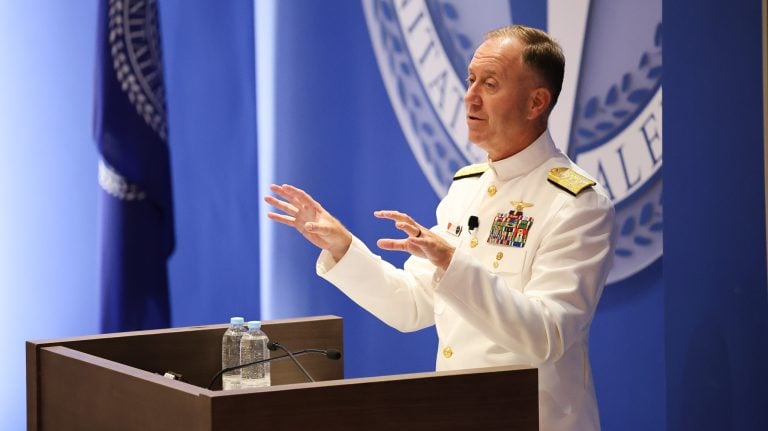
Quoting General Dwight D. EISENHOWER, the Commandant spoke about the philosophy and vision of the NATO Defense College. An environment like that at the College would be difficult to find in any other academic institution. While national academies have only a certain degree of international participation, the NATO Defense College is truly multinational. Another important consideration is that the focus of the College is exclusively on the strategic level. It offers Strategic Courses, with topics of the greatest relevance and interest for worldwide security and NATO – for example, on Collective Defense, Crisis Management and Cooperative Security.
“In a unique multinational setting, we develop what we call ‘human interoperability’, and this is indeed a very important point and essential for successful ‘daily business’ here at the College.”
With these words the Commandant highlighted the importance of openness towards each other, of learning and understanding the variety of perspectives represented by others, of opening one’s eyes to alternative approaches, and of mutual tolerance and respect. In this way prejudices can be overcome and a harmonious atmosphere can be achieved in a multinational, multicultural environment, as is the case here at the NATO Defense College.
After a short break, the College Dean, Dr. Richard Hooker, took the floor to welcome Course Members. He explained in some detail the fundamental Course objective introduced earlier by Lt General LOESER – namely that, even more than gaining knowledge about NATO, participants should develop consensus-building skills, increase their ability at critical analysis and reasoning, and become accustomed to working in a multinational environment.
Active participation in committee work and in lectures is a fundamental part of the learning experience at the NATO Defense College. This is what will prepare participants for future positions in NATO, in NATO-related posts or in other multinational organizations.
To conclude, Dr. Hooker was pleased to remind Course Members that, though the academic programme is central to their experience at the College, living in Rome, the Eternal City, will always offer a most welcome sense of variety to the daily study routine.
NDC Public Affairs Office
(Prepared by Ms Valerie Kasseckert, DEU C)

 Collège de Défense de l'OTAN