

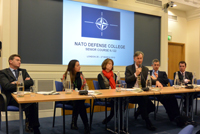
The Field Study programme of Senior Course 122 continued with a visit to London, where the group arrived on 25 March. Course Members were accompanied by the Dean of the NATO Defense College (NDC), Dr Richard D. Hooker (USA C).
The day of institutional visits began at one of the most instantly recognizable buildings in the world, the Palace of Westminster, next to the River Thames. Course Members had the chance to see the House of Commons and Central Lobby, the visually inspiring focal point for access to the Lords, the Commons and Westminster Hall, before hearing a valuable briefing by former Member of Parliament Mr Roger Casale.
Immediately afterwards, a series of political briefings on strategic-level security and defence issues were given. The first was offered by Mr James Gray, Member of Parliament and Chairman of the All-Party Parliamentary Group (APPG) for the Armed Forces. He outlined the main characteristics involved in Parliament’s cooperation with the MOD and the Armed Forces, explaining practical arrangements for keeping Parliament informed. The second speaker was Mr Steve Baker (MP), Vice-Chairman of the APPG for Aerospace, who explained the importance of cooperation between Government and industry and the procedures to be followed for political decision-making. In conclusion, he provided a valuable breakdown of the UK’s public spending in relation to GDP.
The day continued with a briefing by Mr Hugh Bayley (MP), President of the NATO Parliamentary Assembly. He explained the role and organization of the Assembly, and the actions taken to create a constructive dialogue on international priorities among MPs throughout the Alliance. The morning briefings came to a close with a presentation by Ambassador Michael Roberts, a professional diplomat and consultant on international and governmental affairs. He provided clear insights into the responsibilities of the European External Action Service, in cooperation with national diplomatic missions, in ensuring international prosperity and security.
In the afternoon, the group received a number of important institutional briefings at the Ministry of Defence (MOD). Here, Course Members were welcomed by Mr Tom McKane, Director General of Security Policy. He highlighted the UK’s continued commitment to NATO, and to the principle that the defence of the UK is part of the Alliance’s defence. The speaker also made a firm recommendation that more should be done to support NATO, as the most successful international organization of the last 60 years. In closing, he referred to the considerable risks facing the Alliance in the current context.
Col Dan
Hughes, Assistant Head Strategic Direction – Defence Strategy & Priorities at the MOD, then informed Course Members about the challenges in developing the UK’s Strategic Defence Security Review 2015 and National Security Strategy. After this, the focus shifted to the UK’s relations with NATO: Mrs Alison
Stevenson, Head of NATO and European Policy at the MOD, analysed the significant role played by the UK within the Alliance. She explained how information is exchanged within the MOD, more specifically between military and civilian personnel. Finally, she provided a clear picture of the way the UK is handling defence issues within the NATO Defence Planning Process (NDPP).
Course Members then met Ms Claire Moran, Head of the Conflict, Humanitarian and Security Department at the Department for International Development (DFID), who briefed them on the UK’s approach to conflict and instability in the context of development. She gave details of the way DFID, in cooperation with the UK MOD and the Foreign and Commonwealth Office (FCO), approaches a number of challenging issues – ranging from fragile states and societies to dialogue with conflict groups.
The last lecturer of the day was Ms Chloe Squires, Head of Security Policy at the FCO. Her briefing included the prospects for a successful European Security Architecture. She also briefed Course Members on the UK’s vision of the EU Common Security and Defence Policy (CSDP), as well as on the challenges NATO currently faces in its cooperation with the EU. Her concluding remarks underlined the continuing importance of NATO as the cornerstone of the UK’s defence policy.
The session ended with a challenging Q&A session. A range of highly topical questions from Course Members were addressed by the various speakers, who were joined by other distinguished panellists: Mr Steve McCarthy, Director of International Security Policy (DISP) at the Ministry of Defence, together with Brig Gen Tim Bevis and Col Andrew Harrison. All the presentations and the different topics covered throughout the day were fully discussed.

 Collège de Défense de l'OTAN


