Passer au contenu
juin 3, 2026
  • Facebook
  • X
  • LinkedIn
  • Youtube
  • Instagram
  • Flickr
NATO Defense College

Collège de Défense de l'OTAN

Unitatem Alentes

NDC_103x103
  • Home
  • Courses
  • Publications
  • Emplois
  • NDC Foundation
  • FAQs
  • Education mail
Menu principal
  • Home
  • Organisation
    • About Us
      • Mission
      • Qui est qui?
      • Structure
      • Historique
      • Vox Collegii Magazine
    • News
    • Resources & Services
      • La bibliothèque
      • Locaux du Collège de Défense de l’OTAN (NDC)
      • Liens
      • Vision Link
      • FAQS
    • Opportunités
      • Possibilités d’emploi
      • Achats
    • Contact & Information
      • Pour nous contacter
      • Follow us
      • Avis Important
  • Enseignement
    • General Information
      • Cours au Collège
      • e-Learning
      • Calendriers académiques
      • Le projets d’étude
    • Long Courses
      • La Session principale
      • Cours OTAN de coopèration régionale (NRCC)
    • Short Courses
      • Stage pour Officiers généraux et Ambassadeurs (GFOAC)
      • Generals, Flag Officers and Ambassadors’ Course for Partners, GFOAC-P (former SERC)
      • Stages modulaires de brève durée (MSCs)
      • Modular Short Course Partners Integrated (MSC-PI)
    • Partnerships
      • Accord NDC Leicester
      • Accord NDC LUISS
      • Accord NDC Simon Fraser
    • Administration
      • Section des auditeurs
  • Recherche
    • À propos de la recherche
    • Les chercheurs
    • Publications
    • Opportunités
    • NATO NextGen Futures
  • Engagement
    • Conférence des Commandants
    • Semaine de Kiev
    • Anciens’ Seminar
    • Other Engagement
  • Portails
    • Portail académique
    • Anciens
    • Conseil académique consultatif
    • Conseil académique consultatif du NRCC
    • Conférence des Commandants
  • Newsletter
    • Vox Collegii Newsletter
  • fr_FRFrançais
    • en_USEnglish
  • Maison
  • News
  • Senior Course 124, Regional Approaches Field Study: Stockholm
  • News

Senior Course 124, Regional Approaches Field Study: Stockholm

Publié: juin 25, 2014 | Mis à jour: janvier 15, 2026 5 minutes lues
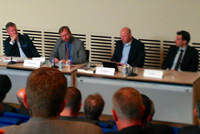
Panel debate: (right to left) Eric PAGLIA, Professor Jan ÅNGSTRÖM, Niklas GRANHOLM and NDC Col Javier AYUELA

Following arrival in Stockholm on Friday 20 June, Course Members enjoyed a relaxing, albeit cool, weekend culminating in a Sunday evening dinner cruise hosted by Brigadier General Bengt AXELSSON, Deputy Vice-Chancellor of the Swedish National Defence College (SNDC).

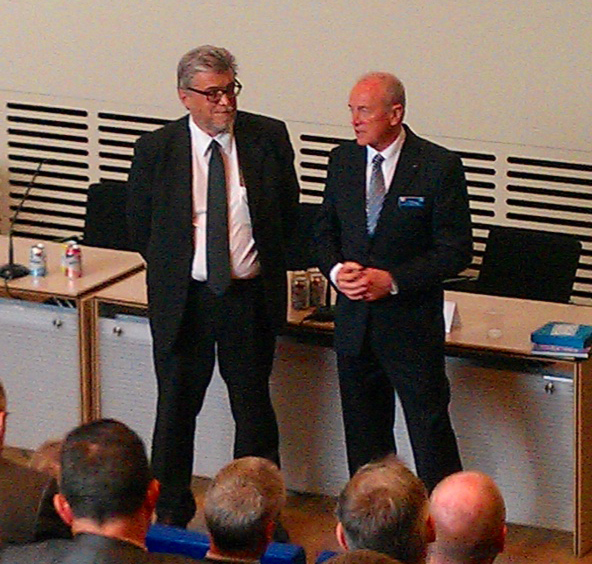
On arrival at the SNDC on Monday morning, Course Members were welcomed by Vice-Chancellor Romulo ENMARK, PhD. He provided a concise overview of how the SNDC supports Swedish defence education, training and research.

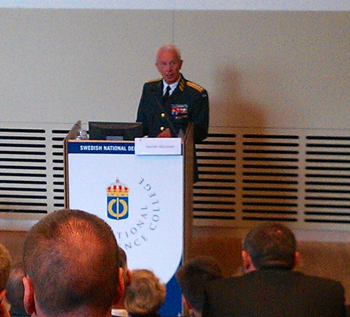
The availability of senior leaders to address the Senior Course during Field Studies is always greatly appreciated, and the talk given by General Sverker

GÖRANSON
, Swedish Chief of Defence, was no exception. He explained the Swedish view of the global situation today, and its correlation to the current and future planning efforts of the Swedish Armed Forces. Russian politics and recent events in Ukraine influence the political discussion in Sweden and, as in other Nordic countries, its dialogue with the Russian Federation remains open while all cooperative military exercises are suspended. The speaker highlighted the 1999 transition from conscription to professional military forces, explaining the associated challenges and opportunities. While the Swedish military enjoys a much higher degree of professionalism as a result of the change, the cost of building, maintaining and developing future requirements has required a reform of the Armed Forces which is currently in its fourth year.

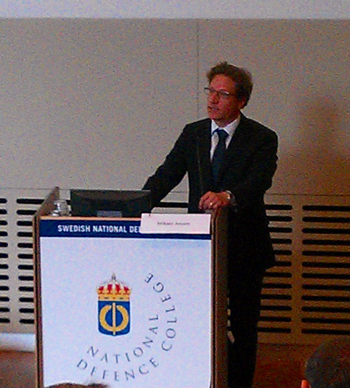
Mr Mikael ANZEN, Deputy Director for Security and Policy, Ministry of Foreign Affairs, provided a lecture on Regional Cooperation in the Arctic. He defined the Arctic not only in terms of its geographical and environmental boundaries, but also in relation to political dialogue (e.g. UNCLOS). Though Sweden is a ‘landlocked’ Arctic nation (with no Arctic Sea shoreline), it maintains nine icebreaker vessels that support both Baltic and Arctic Sea operations. Providing a concise history of Swedish Arctic exploration, and conflicts, the speaker transitioned to current challenges and opportunities; he also referred to the ongoing debate over national boundaries and access of non-Arctic nations to resources. Sweden participates in both the Barents Council and the Arctic Council, both of which have similar aims and interests, albeit with a different geographic focus and membership. In his conclusion, Mr Anzen noted the increasing importance of the Arctic Council as an international decision-making body.

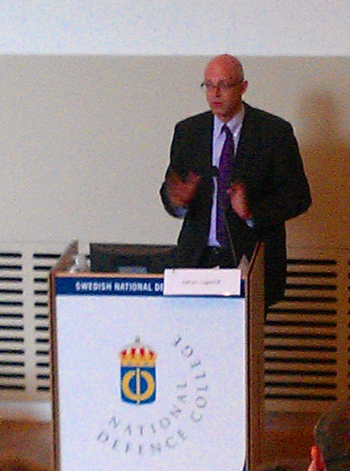
Mr Johan LAGERLÖF, Deputy Director General and Head of Strategy and Security Policy at the Ministry of Defence, provided a security policy overview and also spoke about the impact of the ongoing crisis in Ukraine on national security concerns. His focused discussion of territorial integrity and Swedish political independence provided a sound basis for an appraisal of Swedish military reform and the resulting transition of national policy from concern with territorial defence to emphasis on international partnerships as the basis to security. The Swedish military reform, as a result of a decreasing defence budget and the continuing transition from conscript to professional forces, is creating a smaller, better equipped military. Despite this downsizing, Sweden has increased its capability to integrate its equipment and forces with NATO and regional allies, through technical interoperability and increased training and exercises (including NATO Response Force support). While Sweden maintains its principle of military non-alignment, it continues to build and reinforce relationships with both NATO and the European Union structures.

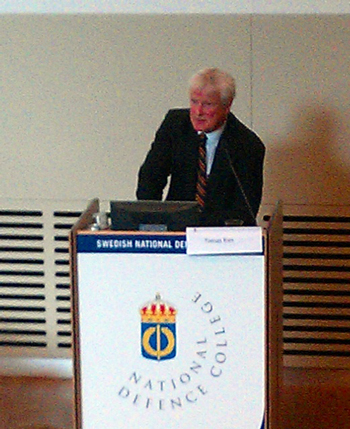
Dr Tomas RIES, Swedish National Defence College, Department for Security, Strategy and Leadership, presented an interesting lecture on Global Security and Nordic Priorities. In the speaker’s view, a rapidly degrading global security environment has combined with continuing technological and economic development to create a scenario which is readily recognized, but difficult to address. Dr Ries commented on not only the Ukraine crisis, but also the long-standing nuclear defence postures of Russia and the United States. He also emphasized the need for a credible European defence capability.

The programme concluded with a panel debate, moderated by Professor Jan ÅNGSTRÖM: this featured presentations by Eric PAGLIA (KTH Royal Institute vof Technology) and Niklas GRANHOLM (Swedish Defence Research Agency, Ministry of Defence). Mr Paglia spoke about the Arctic Council, commenting on the role of member states and observer states (as well as the extent of international interest in Arctic matters, ranging from scientific research stations and energy exploration to concern with the global implications of environmental change in the Arctic). The presence of China, Japan, South Korea and Singapore reflects the geographic spread of the twelve permanent observer states. Mr Granholm described the evolution of regional geopolitical problems resulting from climate change and human activity, as illustrated by the crowded map of declared economic zones in the Barents Sea. He concluded his presentation by citing examples of Arctic nations’ sovereignty policing, and its applicability to strategic security.

In an official exchange of gifts at the conclusion of the programme, Brigadier General Patrick DESJARDINS, NDC Director of Academic Operations, presented a College crest to Vice-Chancellor ENMARK of the SNDC.

NDC Public Affairs Office
Navigation des publications

Précédent : Senior Course 124, Regional Approaches Field Study: Tallinn
Suivant : NDC Research Division outreach and support to the NMIOTC’s 5th Annual Conference, 24-26 June 2014

CLOUD TAGS

Strategy Hindsight Asia/Pacific War Middle East/North Africa NATO Future East Europe and Russia

PUBLICATIONS BY REGION

  • NATO
  • Middle East/North Africa
  • Asia/Pacific
  • East Europe and Russia

PUBLICATIONS BY TOPICS

  • The War Series
  • The Strategy Series
  • The Future Series
  • The Hindsight Series

RESEARCH

  • À propos de la recherche
  • Les chercheurs
  • Publications
  • Opportunités
  • NATO NexGen Futures

Recent Posts

Navigating Multi-Domain Operations: NDC Concludes Modular Short Course 148-2 MSC 148-2 participants during a committee discussion
  • Courses
  • News

Navigating Multi-Domain Operations: NDC Concludes Modular Short Course 148-2

mai 29, 2026
Fostering Cohesion in a Changing Strategic Environment: The 72nd Anciens’ Conference and Seminar NDC Commandant LGEN Nielsen awards MGEN Seewer the Distinguished Ancien diploma
  • Conference
  • Editor's Pick
  • NDC
  • News

Fostering Cohesion in a Changing Strategic Environment: The 72nd Anciens’ Conference and Seminar

mai 15, 2026
Moscow’s views of the war of tomorrow Moscow’s views of the war of tomorrow
  • News
  • Publications
  • The Future Series

Moscow’s views of the war of tomorrow

mai 14, 2026
Strategic Competition and NATO Transformation: Senior Course 148 Transatlantic Field Study SC 148 Course Member during Q&A session
  • Courses
  • News

Strategic Competition and NATO Transformation: Senior Course 148 Transatlantic Field Study

mai 13, 2026
The NDC Concludes Generals, Flag Officers and Ambassadors’ Course 2026-1 148-GFOAC-2026-1_10
  • Courses
  • News

The NDC Concludes Generals, Flag Officers and Ambassadors’ Course 2026-1

mai 8, 2026
Strengthening Partnerships in the Sahel Region Through Education: The NDC Conducts the 5th GFOAC-P Sahel NDC Commandant LGEN Max A.L.T. Nielsen shaking hands with former G5SDC Director Brigadier General Aba Babty El Hadj Ahmed at the G5SDC.
  • Courses
  • News

Strengthening Partnerships in the Sahel Region Through Education: The NDC Conducts the 5th GFOAC-P Sahel

mai 1, 2026

CONTACT US

Central Registry
Collège de Défense de l'OTAN
Via Giorgio Pelosi 1, 00143, Rome - Italy
E-mail: [email protected]

Tu as peut-être manqué

MSC 148-2 participants during a committee discussion
2 minutes lues
  • Courses
  • News

Navigating Multi-Domain Operations: NDC Concludes Modular Short Course 148-2

mai 29, 2026
NDC Commandant LGEN Nielsen awards MGEN Seewer the Distinguished Ancien diploma
4 minutes lues
  • Conference
  • Editor's Pick
  • NDC
  • News

Fostering Cohesion in a Changing Strategic Environment: The 72nd Anciens’ Conference and Seminar

mai 15, 2026
Moscow’s views of the war of tomorrow
1 minutes de lecture
  • News
  • Publications
  • The Future Series

Moscow’s views of the war of tomorrow

mai 14, 2026
SC 148 Course Member during Q&A session
5 minutes lues
  • Courses
  • News

Strategic Competition and NATO Transformation: Senior Course 148 Transatlantic Field Study

mai 13, 2026
Central Registry
Collège de Défense de l'OTAN
Via Giorgio Pelosi 1, 00143, Rome - Italy
Telephone: (+39) 06 50525 309 / 275
Fax: (+39) 06 50525 799
[email protected]
Public Information/media related matters:
[email protected]
Web related matters:
[email protected]
US Postal Address
U.S. National Support Element
Collège de Défense de l'OTAN
PSC 802 BOX 201
FPO AE 09608-0003

UK Postal Address
Name Rank Number
Dept
Collège de Défense de l'OTAN
BFPO 65

RELEVANT LINKS

NATO HQ
SHAPE
NATO ACT
NATO School
NATO Defense College Foundation
  • Organisation
  • Enseignement
  • Recherche
  • Engagement
  • Portails
  • Facebook
  • X
  • LinkedIn
  • Youtube
  • Instagram
  • Flickr
NATO Defense College © 2026 All rights reserved.
NATO Defense College Collège de Défense de l'OTAN
Heureux de vous revoir
Connexion
Connectez-vous pour accéder à vos téléchargements, gérer votre compte et continuer là où vous vous êtes arrêté.
Connexion au compte
Saisissez vos identifiants pour accéder à votre compte
Mot de passe oublié ?
We use cookies to ensure that we give you the best experience on our website. If you continue to use this site we will assume that you are happy with it.