
Headed by the Dean, Dr. Stephen Mariano, Senior Course 134 and participating faculty members of the NATO Defense College visited Portugal on 27th and 28th March as part of the first European Field Study.
On 27th March, the Instituto da Defesa Nacional (IDN) hosted the NDC delegation with a dinner in the Navy Mess Hall in Farol da Guia in Cascais, in the presence of the Deputy Director Mrs. Filomena Baptista, and the Director of the National Defence Course and Head of the Centre for Studies and Research, Mrs. Isabel Ferreira Nunes.
The next day, the delegation was warmly welcomed at the IDN by the Director, Major Ge-neral Vitor Rodrigues Viana, who defended education as key to meeting the new security challenges. NATO and national educational institutions must stay ahead of the challenges and the NDC plays an important role in the adaptation process.
Ambassador Gilberto Jerónimo, Deputy Secretary-General, Foreign Policy in the Portu-guese Ministry of Foreign Affairs delivered the first briefing on ‘Portugal’s Foreign Policy – Constraints and Responses’. He underlined the importance of democratic consolidation following the April 1974 ‘Carnation Revolution’ and explained the six Portuguese tenets of foreign policy: the European space; the Atlantic axis; the Portuguese-speaking world; supporting the growing Portuguese communities abroad; the growing internationalisation of Portugal and unquestioned Portuguese support for multilateralism as a condition for global governance. The Deputy Director General of the Office for Economic Policy and International Affairs of the Portuguese Ministry of Finance, Dr. José Carlos Azevedo Pereira, gave a brief overview of the Portuguese economy. He focused on the imbalances that were building up in the early 2000s and on how Portugal is now overcoming the challenges from the crisis, including through improved public finances, decreasing government debt and a continuation of structural reforms.
Col Dr Nuno Lemos Pires, Professor at the Portuguese Military Academy, delivered the third brief-ing on ‘National Defence. He discussed emerging risks and threats like ‘power deca-dence’; climate change & demographic pressure; new technologies and radical narratives. He concluded that in this rapidly changing situation, Europe needs to agree on its ambitions, its role in Africa and how to deal with the environment, along a comprehensive and multi-faceted design, taking into account de-fence and security; civilian-military efforts; and strategic and tactical levels. He re-iterated Portu-gal’s wish to be a reliable, ready and modern member of NATO and thereby remain a security pro-vider within the Alliance and other fora.
Head of the Strategic Planning Division of the Portuguese Joint Chief of Staff, Brigadier General Maia Pereira delivered the fourth briefing on the Portuguese Armed Forces. He gave details on the legal and strategic planning framework, the level of ambition and the organizational model and structure of the Portuguese Armed Forces. He concluded that Portugal has a modern and integrated national defence and outlined the tasks and re-sources, explaining that recruitment and retainment are ‘a key challenge’. He outlined present and future capabilities and stressed the need to align the NATO Defence Planning Process (NDPP) with the EU’s Permanent Structured Cooperation (PESCO). Finally, he illustrated Portugal's commitment to NATO, the UN and the EU across the globe with its 2.300-strong force.
The Q/A sessions at the IDN were all moderated by Colonel Manuel Rosa, Faculty Adviser and Portuguese Senior National Representative at the NDC.
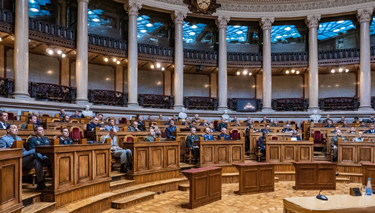
In the afternoon, the delegation visited the Parliament and met with representatives of the National Defence Commission, led by the Vice-President, Mr. Miranda Calha. He stressed that agreement on defence and security must be reached beyond political differences and described how the Commission works on a daily basis with the Ministry of Defence. He stressed the Commission’s work as being essential to providing durable strategic guidance in all defence matters, and to the democratic control of the Armed Forces and the intelligence system. He re-iterated the need for NATO to develop a true 360 degrees approach to meet the challenges, risks and threats, and described Portugal’s role in strengthening European defence cooperation, including capability development within the Permanent Structured Cooperation (PESCO) framework, without duplicating NATO’s capabilities and efforts.
The Q/A session at the Parliament was moderated by the Dean, Dr. Stephen Mariano.
The NATO Defense College group highly appreciated the hospitality and detailed information provided by the Portuguese hosts.
NDC Public Affairs Office
 Collège de Défense de l'OTAN