Passer au contenu
juillet 18, 2026
  • Facebook
  • X
  • LinkedIn
  • Youtube
  • Instagram
  • Flickr
NATO Defense College

Collège de Défense de l'OTAN

Unitatem Alentes

NDC_103x103
  • Home
  • Courses
  • Publications
  • Emplois
  • NDC Foundation
  • FAQs
  • Education mail
Menu principal
  • Home
  • Organisation
    • About Us
      • Mission
      • Qui est qui?
      • Structure
      • Historique
      • Vox Collegii Magazine
    • News
    • Resources & Services
      • La bibliothèque
      • Locaux du Collège de Défense de l’OTAN (NDC)
      • Liens
      • Vision Link
      • FAQS
    • Opportunités
      • Possibilités d’emploi
      • Achats
    • Contact & Information
      • Pour nous contacter
      • Follow us
      • Avis Important
  • Enseignement
    • General Information
      • Cours au Collège
      • e-Learning
      • Calendriers académiques
      • Le projets d’étude
    • Long Courses
      • La Session principale
      • Cours OTAN de coopèration régionale (NRCC)
    • Short Courses
      • Stage pour Officiers généraux et Ambassadeurs (GFOAC)
      • Generals, Flag Officers and Ambassadors’ Course for Partners, GFOAC-P (former SERC)
      • Stages modulaires de brève durée (MSCs)
      • Modular Short Course Partners Integrated (MSC-PI)
    • Partnerships
      • Accord NDC Leicester
      • Accord NDC LUISS
      • Accord NDC Simon Fraser
    • Administration
      • Section des auditeurs
  • Recherche
    • À propos de la recherche
    • Les chercheurs
    • Publications
    • Opportunités
    • NATO NextGen Futures
  • Engagement
    • Conférence des Commandants
    • Semaine de Kiev
    • Anciens’ Seminar
    • Other Engagement
  • Portails
    • Portail académique
    • Anciens
    • Conseil académique consultatif
    • Conseil académique consultatif du NRCC
    • Conférence des Commandants
  • Newsletter
    • Vox Collegii Newsletter
  • fr_FRFrançais
    • en_USEnglish
  • Maison
  • News
  • Senior Course 135 Field Study II: Switzerland
  • News

Senior Course 135 Field Study II: Switzerland

Publié: novembre 13, 2019 | Mis à jour: janvier 15, 2026 4 minutes lues
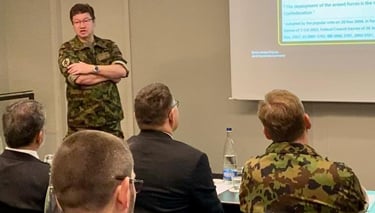
Presentation by LGEN Schellenberg

On Sunday 10 November Senior Course began their visit to Switzerland, with a first stop in the beautiful village of St Gallen for a briefing on security policy at canton level by COL Jörg Köhler, Director of the Office for Civil Protection and Military Affairs and Head of Crisis Management. He spoke about the challenges of the cantons, which are not only experiencing the impact of climate change (e.g., fire risk related to drought, difficult conditions for farmers, effects on fauna) but also faced with challenges such as cyber attacks, management of refugees, changing demographics and animal diseases.

The speaker identified a number of essentials for management of these challenges (promotion of individual responsibility and resilience; cooperation of police, fire brigade, health services, civil protection and other actors). Particular attention has to be given to the country’s high density of critical infrastructure, the aim being to maintain performance permanently with possible support from the Armed Forces. From the operational point of view, the focus is on integrated risk management, the network system (cantonal – intercantonal – national – international) and measures led by the Staff for Crisis Management.

After the briefing the Senior Course visited St Gallen, whose “Stiftsbibliothek” library is designated as a World Heritage Site.

In the evening Lieutenant General Aldo C. Schellenberg, Chief of Joint Operations Command / Deputy Chief of the Swiss Armed Forces, hosted Senior Course 135 for a dinner.

On 11 November, Lieutenant General Schellenberg provided a briefing about the Armed Forces, explaining that almost all citizens belong to them. The budget for defence expenditure is small (0.8% of GPD). Switzerland’s long tradition of neutrality means no involvement in armed interstate conflicts, no use of Swiss territory or airspace by belligerents, and no membership in military alliances. Switzerland must therefore ensure its own defence. Despite Switzerland’s neutrality, there is cooperation and interoperability, though subject to certain conditions. Switzerland provides support for UN Security Council resolutions and for UN peace keeping operations.

There was then a briefing on Swiss security policy, by Nicolas Plattner, Head of Arms Control, Disarmament and Non-Proliferation at the Federal Department of Foreign Affairs. Challenges include illegal manipulation and acquisition of information, terrorism and violent extremism, armed attack, criminality, disruption of supplies and natural catastrophes. With regard to NATO/PfP, the speaker specified that Switzerland is a long-standing and committed NATO partner and the biggest financial contributor to trust funds among the partners. He stressed that preventative measures and dialogue are a must to cope with such challenges as influence operations, hybrid threats and cyber attacks.

Bruno Rösli, Head of Defence and Arms Procurement Policy at the Directorate for Security Policy, Federal Department of Defence, Civil Protection and Sport, then spoke about current policy issues of the Swiss Confederation. In relation to Switzerland’s direct democracy, he explained that the state serves the citizen, who thus effectively “owns the state”; legislative power is delegated by the people to the parliament, but with the option to correct parliamentary decisions. The Swiss citizen elects representatives and decides on issues at federal, cantonal and communal level. S/he can also initiate changes to the constitution and can reject laws adopted by parliament. Switzerland is a federal state with 26 cantons. These are sovereign bodies, within the limits set by the Federal Constitution. They exercise all rights that are not vested in the Confederation, the principle of subsidiarity being the basis for the allocation and performance of state tasks. With the canton taking prime responsibility for its own internal security, the pillars of security strategy are autonomy, cooperation and engagement.

These initial presentations were followed by a panel discussion.

There was then a talk by Dr Oliver Thränert, Head of the Centre for Security Studies (CSS), an independent think tank, which promotes understanding of security policy challenges as a contribution to a more peaceful world. The speaker explained the various domains covered by CSS research. This was followed by a Q&A session.

Finally, the NDC’s Swiss Faculty Adviser Col Curtenaz gave a presentation on Switzerland with particular reference to NATO partnership, examining specific limitations, dependencies and challenges.

NDC Public Affairs Office
Navigation des publications

Précédent : New RD Publication: Calibrating the scope of NATO’s mandate
Suivant : Senior Course 135 Field Study II: Warsaw

CLOUD TAGS

Hindsight NATO Middle East/North Africa War Asia/Pacific Future East Europe and Russia Strategy

PUBLICATIONS BY REGION

  • NATO
  • Middle East/North Africa
  • Asia/Pacific
  • East Europe and Russia

PUBLICATIONS BY TOPICS

  • The War Series
  • The Strategy Series
  • The Future Series
  • The Hindsight Series

RESEARCH

  • À propos de la recherche
  • Les chercheurs
  • Publications
  • Opportunités
  • NATO NexGen Futures

Recent Posts

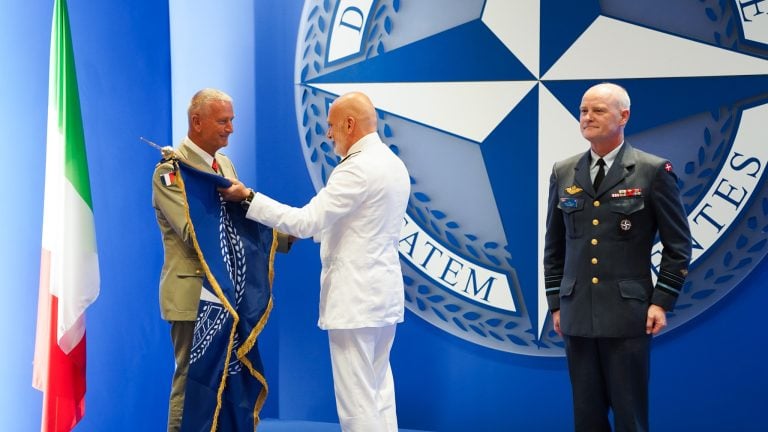
Lieutenant General Max A.L.T. Nielsen Hands Over NDC Command to Lieutenant General Jérôme Goisque Admiral Cavo Dragone hands over the NDC flag to the incoming NDC Commandant LGEN Goisque
  • Editor's Pick
  • News

Lieutenant General Max A.L.T. Nielsen Hands Over NDC Command to Lieutenant General Jérôme Goisque

juillet 18, 2026
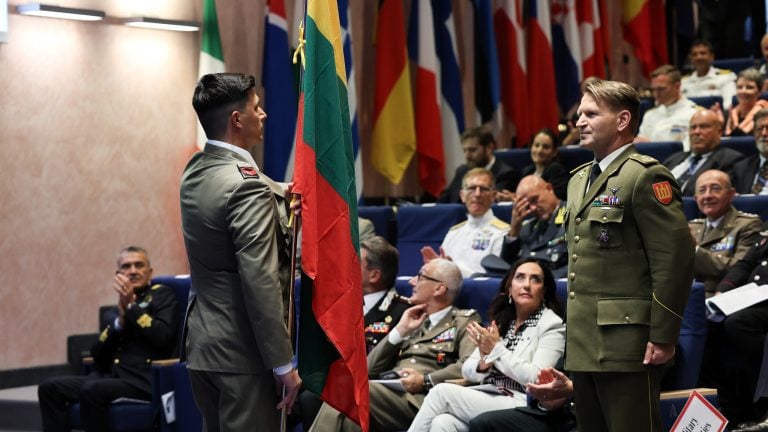
Senior Course 148’s Graduation Marks 75 Years of Developing Future Leaders Course Member of Senior Course 148 saluting his flag
  • Courses
  • News

Senior Course 148’s Graduation Marks 75 Years of Developing Future Leaders

juillet 17, 2026
The NDC proudly celebrates its 75th anniversary & 60 years since its relocation to Rome The arrival of the Chairman of the Military Committee Admiral Guiseppe Cavo Dragone and NDC Commandant Lieutenant General Max A.L.T. Nielsen at the NDC's 75th Anniversary celebrations.
  • Courses
  • News

The NDC proudly celebrates its 75th anniversary & 60 years since its relocation to Rome

juillet 16, 2026
Video: The Mind as a Battlespace: Reshaping Education, Resilience and Decision-Making Video interview: CoC 2026
  • Editor's Pick
  • News

Video: The Mind as a Battlespace: Reshaping Education, Resilience and Decision-Making

juillet 7, 2026
Betting on blue: how to improve NATO military forecasting for acquisitions Outlook 07 2026
  • News
  • Publications
  • The War Series

Betting on blue: how to improve NATO military forecasting for acquisitions

juillet 6, 2026
Building Consensus: Senior Course 148 Simulates NATO Crisis Decision-Making Senior Course 148 participant discussing during the Negotiation, Mediation and Decision-making Exercise
  • Courses
  • News

Building Consensus: Senior Course 148 Simulates NATO Crisis Decision-Making

juin 26, 2026

CONTACT US

Central Registry
Collège de Défense de l'OTAN
Via Giorgio Pelosi 1, 00143, Rome - Italy
E-mail: [email protected]

Tu as peut-être manqué

Admiral Cavo Dragone hands over the NDC flag to the incoming NDC Commandant LGEN Goisque
4 minutes lues
  • Editor's Pick
  • News

Lieutenant General Max A.L.T. Nielsen Hands Over NDC Command to Lieutenant General Jérôme Goisque

juillet 18, 2026
Course Member of Senior Course 148 saluting his flag
5 minutes lues
  • Courses
  • News

Senior Course 148’s Graduation Marks 75 Years of Developing Future Leaders

juillet 17, 2026
GOISQUE Jérôme
2 minutes lues
  • Qui est qui?

Le Commandant

juillet 17, 2026
The arrival of the Chairman of the Military Committee Admiral Guiseppe Cavo Dragone and NDC Commandant Lieutenant General Max A.L.T. Nielsen at the NDC's 75th Anniversary celebrations.
6 minutes lues
  • Courses
  • News

The NDC proudly celebrates its 75th anniversary & 60 years since its relocation to Rome

juillet 16, 2026
Central Registry
Collège de Défense de l'OTAN
Via Giorgio Pelosi 1, 00143, Rome - Italy
Telephone: (+39) 06 50525 309 / 275
Fax: (+39) 06 50525 799
[email protected]
Public Information/media related matters:
[email protected]
Web related matters:
[email protected]
US Postal Address
U.S. National Support Element
Collège de Défense de l'OTAN
PSC 802 BOX 201
FPO AE 09608-0003

UK Postal Address
Name Rank Number
Dept
Collège de Défense de l'OTAN
BFPO 65

RELEVANT LINKS

NATO HQ
SHAPE
NATO ACT
NATO School
NATO Defense College Foundation
  • Organisation
  • Enseignement
  • Recherche
  • Engagement
  • Portails
  • Facebook
  • X
  • LinkedIn
  • Youtube
  • Instagram
  • Flickr
NATO Defense College © 2026 All rights reserved.
NATO Defense College Collège de Défense de l'OTAN
Heureux de vous revoir
Connexion
Connectez-vous pour accéder à vos téléchargements, gérer votre compte et continuer là où vous vous êtes arrêté.
Connexion au compte
Saisissez vos identifiants pour accéder à votre compte
Mot de passe oublié ?
We use cookies to ensure that we give you the best experience on our website. If you continue to use this site we will assume that you are happy with it.