

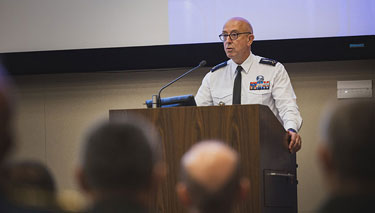
On 3 October 2023, Senior Course 143 continued the North American leg of its Transatlantic Field Study at the Headquarters of Allied Command Transformation (ACT) in Norfolk, Virginia and at Joint Force Command Norfolk (JFC NF).
The NDC group, led by NDC Commandant Lieutenant General Max A.L.T. Nielsen, was welcomed by the Supreme Allied Commander Transformation (SACT), General Philippe Lavigne, who gave his welcome remarks and some initial background on ACT’s role. The NDC delegation then participated in a series of discussions on NATO Allied Command Transformation engagements and priorities. Topics included the NATO Warfighting Capstone Concept, multi-domain operations, digital transformation, and emerging and disruptive technologies. In the afternoon, a very interesting tour on board aircraft carrier USS George Washington rounded off the daily programme.
Colonel Gintaras Koryzna, Faculty Advisor and Senior National Representative (SNR) of Lithuania at the NATO Defense College spoke first as the moderator for the day, introducing General Lavigne, SACT. The general began by thanking LGEN Nielsen and Course Members of SC 143 for visiting ACT, and went on to provide an overview of ACT activities, introducing concepts which were then elaborated further by subsequent briefers. GEN Lavigne also took questions from Course Members on how NATO can make itself more attractive and facilitate the recruitment process, and on the different positions adopted by NATO and the US regarding China.
The next presentation was led by Vice-Admiral Guy Robinson, Allied Command Transformation’s Chief of Staff, who talked about ACT’s frameworks and linkages, underscoring the importance of transforming the military instrument for NATO’s future and for Allies. In this context, multi-domain operations, interoperability and digital transformation play an important role, as well as emerging and disruptive technologies (EDTs). All of those factors need to be taken into consideration to understand future capability requirements and to study future operating environments, concluded VADM Robinson.
An overview of the NATO Warfighting Capstone Concept (NWCC) and Warfare Development Agenda (WDA) was then provided by Lieutenant Colonel Alfredo Marroncelli. Regarding the NATO Warfighting Capstone Concept, developed by ACT in 2021, LTC Marroncelli noted that its role in strengthening NATO’s deterrence and defence posture and offering a vision for maintaining and further developing NATO’s military advantage by continuously adapting the military instrument of power into the future. The WDA is the framework through which the SACT manages the planning and implementation of the NWCC. This instrument sequences and synchronizes Allied warfare development efforts around the five warfare development imperatives and six critical enablers, as well as the associated lines of delivery, as explained by the briefer.
The following presentation, entitled “The Impact of Technology and Digital Transformation on Warfare”, was delivered by Mr Krzysztof Skurzak, from the Requirement Division – Innovation Branch, who touched on the following topics: the impact of technology in the Ukraine war; NATO’s effort to support warfighting adaptation as a way to build a decisive military advantage; and the importance – for Nations – of investing in interoperability, interconnectivity and capability development.
Subsequently, Colonel Stephan Pillmeier, from the Strategic Plan and Policy Directorate – Concept Development Branch, presented an overview on “Multi-Domain Operations, Concept and Way-Ahead”, speaking about the importance of MDOs in military operations and how activities, both military and non-military, orchestrated across the 5 domains (cyber, space, air, land and maritime), can generate effects in the three dimensions: virtual, cognitive and physical. NATO and Allies need to be faster in the adaptation process, especially in terms of synchronization activities and collaborations with various actors involved, concluded the speaker.
Lieutenant Colonel Guy De Decker, from the Capability Development (CAPDEV) Division, addressed the digital transformation within NATO, the ongoing transition process from the platform-centric phase to the data-centric phase, through the platform-centric network-enhanced phase, i.e. the phase NATO finds itself in today. LTC De Decker added that the main goal of this process is the possibility to share large quantities of data across different platforms, adapting current organizations, tools and platforms for multidomain operations. He pointed out that the transformation process is not just about technology but also about people, processes, policies and procurement, and that the contribution of Nations played a vital role in that sense.
The last item of the morning session was an interactive panel discussion with panellists Vice-Admiral Guy Robinson, ACT’s Chief of Staff; Rear Admiral Placido Torresi, Deputy Chief of Staff Joint Force Development at ACT; and Brigadier General Thorsten Lyhne Jørgensen, Assistant Chief of Staff Requirements at ACT. After a short introduction of the panellists and topics of discussion, Course Members were given the opportunity to interact with the panel, gaining deeper understanding of various topics such as how climate change can impact operational environments; the Alliance’s strategy on artificial intelligence, and specifically on how to exploit AI in the different dimensions; technological transformation and cultural adaptation, which is considered one of the most difficult challenges; and NATO investment in space capabilities.
After lunch, Course Members were given an overview of Joint Force Command Norfolk (JFC NF) in a presentation delivered by Rear Admiral Frédéric de Rupilly, Deputy Chief of Staff Plans at JFC NF. He started with some background information on JFC NF and on the strategic context in which it operates. He then went on to speak about the Command’s establishment, military strategy and operating environment. RADM de Rupilly also elaborated on the JFC NF structure and national contributions, before opening the Q&A session with Course Members.
This concluded the ACT and JFC NF portion of the visit to Norfolk, which continued with a very interesting visit to aircraft carrier USS George Washington, where the NDC delegation gained valuable knowledge on this important ship within the US Navy.
NDC Public Affairs Office
 Collège de Défense de l'OTAN