
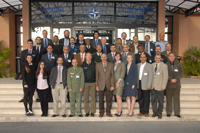
From 13th to 15th November 2013, the Middle East Faculty of the NDC, and NRCC-10 in particular, hosted a three-day interactive seminar to discuss the international and domestic aspects of a hypothetical scenario, set against a background of volatility.
The US-based asymmetric warfare experts and facilitators, who moderated, proposed a simulation exercise in crisis management, focussing on the vital role played by the Comprehensive Approach in attempting to solve such a complex situation. Course Members were split into two committees, and tasked to produce a critical and realistic analysis of a potential crisis in the envisaged setting.
The main purpose of the exercise was to enhance strategic thinking and coordination of efforts by working in a multinational set-up, focussing not on the results but rather on the means to achieve stability, by adopting a wider perspective and by assessing all the possible ramifications of any potential solution.
The initial task was to assess the degree of stability and security within the country concerned and then use that as a centre of gravity, from which to build up a judicial system, to provide law enforcement and to eliminate warlords. Course Members were encouraged to reflect on what instruments to use, choosing from various fields: diplomacy, politics, intelligence, economics, law, the social sciences and military affairs.
The NATO Defense College and the Middle East Faculty are firmly convinced that this exercise was extremely beneficial for the enrichment of relations between NATO and Partner nations.
NDC Public Affairs Office


 Collège de Défense de l'OTAN