

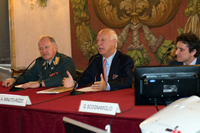
On Thursday 13th and Friday 14th February 2014, the NATO Defense College Foundation held its third Conference. Entitled “Security in a no one’s world? Game changers”, the event took place at Palazzo de Carolis in Rome. Distinguished guests and participants included a number of NDC Foundation Board Members: the Rt Hon Lord Robertson, Honorary Chairman of the NDC Foundation and former NATO Secretary General; H.E. Ambassador Alessandro Minuto-Rizzo, President of the Foundation; H.E. Ambassador Kolinda Grabar-Kitarovič, Senior Adviser to the Foundation and NATO Assistant Secretary General for Public Diplomacy; LtGen Arne Bård Dalhaug, Commandant of the NDC; and Dr Daria Daniels Škodnik, Dean of the NDC. The Conference was attended by directors and senior company officials from the energy, security and defence sectors, as well as ambassadors and diplomats from allied and partner countries.
Opening remarks were given by Ambassador Minuto-Rizzo, LtGen Dalhaug and by Mr Giuseppe Scognamiglio, Executive Vice President for Public Affairs, Unicredit.
Established in 2011, the NDC Foundation focuses on major strategic, security and geopolitical questions: through education and research, it aims to promote a broader understanding of these topics as a necessary stepping stone towards the strategic awareness which is so crucial in the fast-changing international and regional environment. Such is the rationale for this year’s focus on game changers: the international community must constantly strive for a balanced and informed understanding of political, economic, environmental and energy-related questions, in order to address the crucial issues on which the future increasingly depends.
During this year’s Conference, major topics of current global interest were discussed in four dedicated panels (two on Thursday, and two on Friday). On the first day, the topics were the strategic achievements and future challenges of the international community in the wider region of Central Asia; and the consequences of the Arab Spring, with the prospects for a peaceful political solution in the Arab region.
At dinner, guests were addressed by Lord Robertson.
On the second day, the focus was on energy-related themes and the defence industry: the first of the days’s two panels examined the potential opportunities and risks of shale gas technology, with particular reference to its effects on global geopolitical balance and future security strategies; the concluding panel discussed the impact of the economic crisis on defence budgets and, ultimately, on the future of the defence industry and its continuing ability to invest adequately in research and development.
The Conference closed with a working lunch, offering guests and attendees ample scope for a lively discussion of the many points raised during an intense and highly stimulating two days.
NDC Public Affairs Office
 Collège de Défense de l'OTAN