
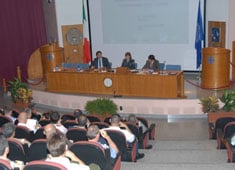
Following Module A of the academic curriculum on security policy and strategy, discussion of the concepts and theories and key areas of the current security environment continued with the start of Senior Course 115 lectures exploring Euro-Atlantic Security Architecture. Study Period B1 on International Organizations, held during the week from 28 September until 2 October 2009, was devoted to an analysis of the international security framework within which NATO operates. Study Period B1 focuses on two key international organizations within the Euro-Atlantic security community, the United Nations and the European Union, as well as non-state actors, such as non-governmental organizations, multinational corporations, cartels and contractors. Although these entities have slowly evolved, there are important questions regarding the continued relevance of the current “system”. How can these organizations do more to enhance international security and stability, and can they cooperate more effectively in order to achieve this common goal?
It was only natural that the academic week should start with a lecture on the United Nations as the stronghold of shared values and commitments to peace, security, freedom and prosperity for all. Dr Mats Berdal, Professor of Security and Development at King’s College, London, delivered the first Study Period lecture, concerning the United Nations. Among other topics, he focused on the issue of UN reform, the pros and cons of its existence, and its future prospects. Despite its imperfections and the frequent criticisms levelled at it, the UN is still the most important and most comprehensive International Organization, and is clearly indispensable.
Today’s European Union (EU), as a supranational organization of 27 countries across the European continent, stands as an unprecedented phenomenon in the annals of history. But even as the EU grows in size and prosperity, there appears to be a limit to how closely Europeans want to embrace a centralized European integration. Dr Peter Van Ham, Director of the Global Governance Research Program at the Clingendael Institute, explored all the aspects of the European Union – its past, its priorities and its prospects. Among several contentious issues, he discussed whether the future Union would be wider and weaker, whether there would be a single European entity or many entities, whether the EU would be a global player or a regional “superpower”, and the nature of its relationship with the United States.
The separate lecture, on European Defense and Security Policy (ESDP) as a major element of the Common Foreign and Security Policy pillar of the European Union, was delivered by Dr Julian Lindley-French, Professor of Military Art & Science at the Royal Military Academy of the Netherlands and Senior Associate Fellow at the Defence Academy of the United Kingdom, and Senior Scholar at the Centre for Applied Policy at the University of Munich. He focused on the issue of coherence between ESDP and NATO in the field of enhancing military capabilities, and called for strong leadership to ensure the successful transformation of European military forces, noting that now is the right strategic moment to take ESDP forward, while criticizing the gap between ambitions and resources.
The Study Period continued with a lecture on the Non-Governmental Organizations that are playing an increasingly important part throughout the world, tackling issues that individual states alone either cannot address or choose to ignore. They are characterized by their great diversity and comprise a mass of different-sized organizations with various management structures and diverse missions. To introduce us to NGOs and Civil Society, we welcomed Mr Gianni Rufini, an expert on international aid, currently Subject Matter Expert (Humanitarian Aid) for the NATO Joint Warfare Centre and Coordinator of the Crises Monitoring Group, and Dr Alain Deletroz, Vice-President ( Europe) of the International Crises Group. Dr Deletroz is an expert on Russia, Caucasus and Central Asia, Latin America, conflict assessment and conflict resolution, democratic reforms and humanitarian assistance. The comments made by the two speakers underlined the fact that NGOs are here to stay and have become increasingly important global actors. They now compete with states and international organizations and can have an important influence on those who actually formulate policy. But are they the first step towards an “international civil society”, or do they represent a dangerous shift of power towards unelected and unaccountable special-interest groups? Both lecturers succeeded in bringing about another interesting academic day at the NATO Defense College.
Given the great importance of economic globalization and the role of transnational corporations, cartels and contractors as a part of it, a new topic was introduced into Senior Course 114’s academic curriculum. To discuss the “Multinational Corporations, Cartels and Contractors” and evaluate their influence on security and stability, the College hosted Dr Tim Büthe, assistant professor in the Department of Political Science and Associate Director of the Centre for European Studies at Duke University, and Mr Rem Korteweg, from the Hague Center for Strategic Studies. Dr Büthe’s lecture focused on multinational corporations and cartels, and he discussed some of the implications for peace and stability during the Q&A session. Does enhanced international commerce have a stabilizing effect over time? Can international commerce promote peace? These are the questions that need to be considered with care. Mr Korteweg covered the role of Private Military Security Contractors and the implications of their involvement in the conflict zones. Do they cooperate with other actors or can they become part of a “Comprehensive Approach”? All these and many more issues were raised during the Questions and Answers session.
The key International Organizations were born in the aftermath of the Second World War and were all designed, in one way or another, to ensure that no such global conflagration occurred again. The contemporary international security environment is, of course, very different from the one that existed when these organizations were formed, and they have all had to evolve to adjust to the new challenges that they are facing. The need for change and reform is constant, a theme that the Senior Course 115 successfully and with great interest discussed and developed.
NDC Public Affairs Office
 NATO Defense College