
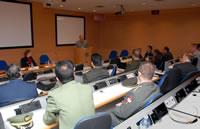
The inauguration ceremony for the fifth NATO Regional Cooperation Course (NRCC) took place on Monday, March 7, 2011 at the NATO Defense College (NDC) in Rome. The inauguration speech was given by the Commandant of the NDC, Lieutenant-General Wolf-Dieter Loeser.
This particular NRCC is extremely important considering the current events in the Middle East, and the fact that this course is one of the largest to date. With a total of 26 participants from 16 countries, NRCC-5 will provide course members the possibility to study and analyze security issues concerning the broader Middle East and their relationship with NATO. The aim of the course is to link issues of concern both to Mediterranean Dialogue (MD) and Istanbul Cooperation Initiative (ICI) nations and to NATO while developing mutual understanding and networking opportunities among participants. This class is unique in that it is attended by two Saudi Arabians, an Austrian, and two members from the United States, all firsts for the NRCC. It is also significant to note that both Egypt and Tunisia are actively participating in the course.
In his opening address, the Commandant brought attention to the diverse makeup of the group while acknowledging the value of the current participation by the League of Arab States. Throughout his speech, the Commandant spoke on the shared challenges faced by both NATO and its partners, including terrorism, failed or failing states, weapons proliferation, and regional stability. The Commandant also spoke about emerging threats such as energy security, climate change and water scarcity. As a general theme, he said, “NATO, along with its partners needs to adapt to confront these threats” and he highlighted the importance of partnerships both inside and outside of NATO in addressing these problems. As an example, both the MD and ICI have matured greatly in consultation and active cooperation, contributing to solutions to problems in the Middle East. Supporting this effort, NRCC-5 seeks to further develop those relationships in “creating a basis for further mutual understanding” while “overcoming misconceptions and changing perceptions”.
The current situation in the Middle East was also prominent in the speech. As the Commandant stated, “we are witnessing rapid change” and “worrisome security developments”. Now, more than ever, the concept of an academic course such as the NRCC seems necessary to advance cooperation and stability in a critical region. The Commandant cited a recent NDC research publication, “The Arab Explosion,” which reiterates the importance of this period in history whereby specific questions regarding the Alliance and its partners will be asked and answered.
The NRCC is a ten-week course held twice a year, and was developed at the 2006 Riga Summit in response to a decision by the Alliance to foster a deeper dialogue and cooperation in education among MD and ICI countries and NATO.
NDC Public Affairs Office


 NATO Defense College