
Following on from Senior Course 120’s Study Period A, which analyzed the security environment of the 21st century in terms of fundamental processes, conceptual issues, specific trends and their significance for NATO, Study Period B focused on the international security framework within which the Alliance operates. Against this background, lectures and discussions during the week of 12th-16th March 2012 examined the key international organizations and non-state actors which play key roles in the Euro-Atlantic and global security architecture.
Meeting today’s security challenges requires a broad spectrum of civil and military instruments, close cooperation and coordination amongst a variety of actors, and a comprehensive approach by the international community. In this perspective, part of the Study Period was obviously dedicated to the two key international organizations for the Euro-Atlantic security community, the United Nations and the European Union, highlighting the latter’s Common Security and Defence Policy (CSDP). In addition, there was an important complementary perspective on how the global security equation must include non-state actors such as civil society, non-governmental organizations (NGOs) and regional organizations (with particular reference, during the Study Period, to the African Union and the League of Arab States).
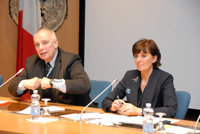
It was only natural that the week should start with a panel lecture on the United Nations – the embodiment of cooperation among States to safeguard peace based on shared values and on the promotion of security, freedom, prosperity for all, prevention of war among states, order and justice. The lecturers were Dr Mats Berdal, Professor of Security and Development at King’s College, London and Mr. Marc Garlasco, Senior Military Advisor to the International Commission of Inquiry on Libya in the UN’s Office of the High Commissioner for Human Rights. Among the topics covered were the issue of UN reform, the organization’s role and limitations, as well as its future prospects. Despite its flaws and the frequent criticisms levelled at it, the UN still makes an indispensable contribution as the international organization with the most prominent position and the most comprehensive mandate. Although a strange amalgam of idealism and realism, it would surely have to be invented if it did not already exist.
Today’s European Union (EU), a supranational organization of 27 sovereign states across the European continent, stands out as an unprecedented phenomenon in the history of international relations: a core group of what later became EU members first established a zone of peace, in the Kantian sense, with the Treaty of Rome in 1957. Despite this enduring achievement, even as the EU grows in size and prosperity there appears to be a limit to how closely Europeans want to embrace centralized European integration. Dr Peter Van Ham, Director of the Global Governance Research Program at the Clingendael Institute, explored various perspectives on the European Union – its past, its priorities and its prospects, as well as the contemporary challenges to the ability of its member states and institutions to build a strong community that can manage Europe’s interaction with the global economy.
A separate lecture was dedicated to the European Union’s CSDP. This major element of the EU’s Common Foreign and Security Policy was addressed by Prof. Julian Lindley-French, Eisenhower Professor of Defence Strategy at the Netherlands Defence Academy, Professor of Strategic Studies at Leiden University and Head of the Commander’s Initiative Group (CIG), Allied Rapid Reaction Corps. Prof. Lindley-French focused on the development of a CSDP to deal with current realities and future challenges, the EU’s role in crisis management, the military component, and EU-NATO cooperation in the framework of the Comprehensive Approach. The quality of the ensuing discussion reflected a particularly thought-provoking day in the Senior Course syllabus.
The Study Period continued with a lecture on civil society and NGOs. Both now play an important part in world affairs, tackling issues that individual states alone are either not able to address or choose to ignore. Two organizations were examined: the International Crisis Group (ICG), presented by Dr Alain Deletroz, ICG Vice-President (Europe), and the International Committee of the Red Cross (ICRC), discussed by Mr. Peter Evans, ICRC Regional Delegation Belgrade. Meeting today’s security challenges requires a broad spectrum of civil and military instruments, and close cooperation and coordination among a variety of actors. Within this overall setting, a number of important factors in ensuring effective cooperation to deal with security threats were discussed during the question-and-answer session.
Given the growing importance of regional organizations, they have become an inescapable feature of global politics. Virtually all countries in the world are members of at least one regional organization – whether in Europe, Asia, the Americas, Africa or the Middle East. These organizations have gradually extended their field of interest from their traditionally economic and political objectives into the security sphere, developing their capacities in conflict prevention, peacekeeping and post-war reconstruction. Two pivotal regional organizations were presented to the Senior Course: the African Union and the League of Arab states. The African Union was discussed by Prof. Ademola Abass, Head of Program and Research Fellow in Regional Peace and Security at the United Nations University Institute for Comparative Regional Integration Studies in Bruges, Belgium. For the League of Arab States the speaker was Dr. Bahgat Korany, Professor of Political Science at the American University in Cairo, Fellow of the Royal Society of Canada and Research Professor at the University of Montreal.
Placing the Study Period as a whole in perspective, the key international organizations were born in the aftermath of the Second World War and were all designed, in one way or another, to ensure that no global conflagration of this kind would occur again. Over the past decade, the Euro-Atlantic security community has been adapting in order to cope with the challenges of the post-Cold War era. During this time, and particularly with the emergence of new security risks and threats since September 11, it has become increasingly necessary to confront issues with both regional and global implications. We are now facing complex, often inter-related threats, which can be addressed only by common efforts and common action. The need for adaptation through reform is constant – a theme which Senior Course 120 discussed with great interest and developed in considerable depth.
NDC Public Affairs Office
(Prepared by Ms. Daria Daniels Skodnik, NDC Visiting Scholar)
 NATO Defense College