
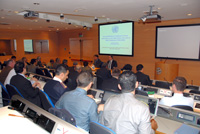
On 11 March 2013 the NDC was honoured by the presence of a distinguished guest lecturer, in the person of Mr Nicolas Kasprzyk (FRA C), who addressed the ninth NATO Regional Cooperation Course 9 (NRCC 9) on the topic “United Nations Security Council Resolution 1540: Non-proliferation of Weapons of Mass Destruction”.
Mr Kasprzyk is currently part of the Expert Group assisting the 1540 Committee, which promotes and coordinates the implementation of United Nations Security Council Resolution (UNSCR) 1540. From 2002 to 2009, he was an adviser on non-proliferation and disarmament at the French Ministry of Defence’s Directorate for Strategic Affairs (Délégation aux affaires stratégiques). Previously, from 1999 until 2002 he worked as a researcher at the Center for International Security and Arms Control Studies (CESIM).
The speaker provided an extensive and authoritative overview of UNSCR 1540, unanimously adopted in 2004. In accordance with Chapter VII of the United Nations Charter, UNSCR 1540 affirms that proliferation of nuclear, chemical and biological weapons and their means of delivery constitutes a threat to international peace and security. All states are thus obliged to refrain from in any way supporting non-state actors in developing, acquiring, manufacturing, possessing, transporting, transferring or using nuclear, chemical or biological weapons and their delivery systems.
The Resolution also encourages international cooperation in this field, and asserts support for the multilateral treaties whose aim is to eliminate or prevent the proliferation of weapons of mass destruction (WMD). A fundamental requirement in this respect is that all states should implement these international agreements in their entirety.
In April 2006, UNSCR 1673 extended the mandate of the 1540 Committee for a further two years, with a view to intensification of its efforts to promote full implementation of UNSCR 1540.
This was followed in 2008 by UNSCR 1810, which urged the 1540 Committee to continue strengthening its role in facilitating technical assistance and requested it to consider a Comprehensive Review of the status of implementation on UNSCR 1540.
Finally, UNSCR 1977 (April 2011) extended the mandate of the 1540 Committee until 2021. UNSCR 1977 also included provision for two Comprehensive Reviews by the Committee during this extension of its mandate, as well as enhancement of its cooperation with relevant international organizations.
Mr Kasprzyk’s greatly appreciated lecture was complemented by the detailed and very informative discussion which followed.
For more detailed information about United Nation Security Council Resolution 1540 (2004), please visit: http://www.un.org/en/sc/1540/
NDC Public Affairs Office
(Prepared by Ms Francesca Blasi, ITA C)


 NATO Defense College