
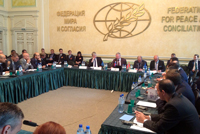
The third stop on Senior Course 122’s Regional Approaches Field Study was Moscow, where Course Members arrived on the evening of Thursday 13th June. The following morning the NDC delegation assembled in the “Peace Avenue” Conference Centre for a full day of briefings and presentations, offering several different perspectives on Russia’s security challenges and enabling a far greater understanding of current NATO-Russia relations. The frankness and openness of the presentations and discussions were very much appreciated by participants and the different views expressed during the Q&A sessions offered a lively complement to the long day’s more academic presentations.
Course Members were welcomed by Professor Alexander Nikitin, Director of the Centre for Political and International Studies, who opened the day’s proceedings. His presentation was followed by a briefing on “Modern Russian Foreign Policy Priorities” by Mr Sergey A. Bazdnikin, Deputy Director of the Department for Foreign Policy Planning at the MFA of the Russian Federation. In the following Q&A session a number of challenging questions were raised, focussing mainly on Russian foreign policy, with a special emphasis on the world’s current “hot spots” (e.g. Syria) and their economic implications, as well as Russia’s initiatives in the field of international security.
Next, there was a panel lecture on “Russia’s policy against terrorism: the challenges of Islamic fundamentalism and lessons learned from operations in the Northern Caucasus”, by Army General Anatoly S. Kulikov, former Minister of the Interior of the Russian Federation, Deputy Prime Minister of Russia and Commander of the Internal Troops of Russia, currently President of the Russian Military Commanders’ Association, and Lt General Vladimir B. Dmitrin, former Commander of the Internal Troops in the Northern Caucasus, currently Chairman of the Board of the Russian Military Commanders’ Association. The broad and informative presentation paved the way for a productive panel discussion.
The following briefing, dedicated to “The Collective Security Treaty Organization (CSTO): priorities, activities and interaction of the CSTO with other international organizations”, was given by Ambassador Alexander A. Churilin, Counsellor at the Department for Political Cooperation, International Secretariat, CSTO. The briefing touched upon a number of interesting points, relating to the recent efforts made on cooperation and collaboration between organizations in support of international security and stability.
Another interesting briefing, entitled “Russia and The West: diverging and common values and interests, views of civil society on Russian foreign policy and relations with NATO”, was given by Dr Igor Yurgens, Director of the Institute of Contemporary Development (INSOR), and by Dr Victor I. Kamyshanov, President of the International Federation for Peace and Conciliation (IFPC).
The last briefing of the day examined “Modern status and prospects for further development of the Russian Armed Forces”. This talk was given by Col Alexander V. Dolgopolov, Academy of the General Staff of the Armed Forces of the Russian Federation, who provided a broad overview of the most recent developments within the Russian Armed Forces.
Senior Course 122 visited Moscow to learn, and was grateful for the presentations and answers which helped to make the visit such a great success. Great credit is also due to Professor Alexander Nikitin and his team at the Centre for Political and International Studies, with whom the NDC enjoys excellent relations.

 NATO Defense College


