
On Friday 13th December, SC 123 visited Turkey’s capital, Ankara.
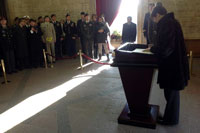
Located in the Central Anatolia region and home to the Grand National Assembly of Turkey, Ankara is a hub of many great civilizations. In this beautiful location, the NDC delegation first visited Atatürk’s Mausoleum, where Course Members attended a military ceremony, before moving to the headquarters of the Turkish General Staff (TGS HQ), where they were briefed on Turkish foreign and defence policies. Dr Daria Daniels Škodnik (SVN C), Dean of the NATO Defense College (NDC), had the opportunity to meet with LtGen Akın Öztürk (TUR F), Chief of Operations at TGS, to discuss international issues.
SC 123 was welcomed by MajGen Yavuz Turkgenci and by Col Samettin Öremiş, Head of NATO Strategic Branch TGS, who gave an interesting briefing on “Turkey’s Contribution to Regional and Transatlantic Security”. He stressed that Turkey’s role and place within NATO has altered in keeping with transformations within the Alliance. With its strong historical, economic and cultural links to Central Asia and the Middle East, Turkey is a vital bridge to project security in these areas. The briefings stressed some aspects of defence policy, such as the military training cooperation activities which Turkey is engaged in. In fact, almost 27,000 military from 52 different nations have been involved in training activities organized by Turkey on its territory. Moreover, the Defence General Staff is proud of its Centre of Excellence on Defence against Terrorism, where more than 7,300 participants from 105 nations have attended courses.
The briefing examined the Smart Defence initiatives undertaken by Turkey, such as the Multinational Maritime Security Centre of Excellence (which also acts as a think tank) and the Multinational Military Flight Crew Training Unit. Information was then given on Turkey’s involvement in international missions, with details pertaining to the ISAF withdrawal from Afghanistan and Turkey’s policy after 2014.
The second briefing by First Counsellor Kaan Orbay, Head of the Directorate General for Policy Planning, Ministry of Foreign Affairs, analysed Turkey’s foreign policy. Included among Turkish priorities are: closer relations with neighbouring countries; playing an active role in international fora (non-permanent member of UN Security Council, member of the G-20, with the presidency to be held in 2015, etc); strengthening existing strategic relations (EU membership is a strategic target for Turkey); and opening up to new geographic partners (strategic partners with the African Union since 2008, trade with Africa increasing from 2 billion US$ in 2012 to a scheduled 100 billion US$ by 2023). Counsellor Orbay then went on to explain that “Turkey has four areas of major interest, which are the Balkans, the Middle East, the Caucus and Central Asia,” and gave details on Turkey’s objectives in each of these areas.
During the afternoon, the delegation visited the Undersecretariat for Defence Industries (SSM), established in 1985, where Course Members attended a briefing on the “Turkish Defence Sector”. Since the creation of the SSM 27 years ago, significant steps have been taken to equip the Turkish armed forces with modern systems and technology, and to promote the development of the Turkish defence industry. Paramount for Turkey, in recent years, has been home-grown product development. Many platform projects have been successfully executed by using local design and system integration capabilities. Since 2002, the turnover in contracted projects by the defence industry has been increasing steadily and is now over 2.7 billion US$. As stated in the SSM Strategic Plan, increased local participation is one of the main indicators of the improving abilities and greater competence of Turkish industry. According to the Export Strategy Document published by SSM in 2009, international cooperation is defined as one of the key priorities, with Turkish industry’s growing capabilities playing an increased role in international partnerships and expanding into new, emerging markets in different parts of the world. Today, according to the speaker, shrinking budgets in many developed economies are forcing change to their rigid national policies, as they become more receptive to international cooperation. Data were supplied, indicating that the volume of Turkish defence exports, including civil aviation, has reached 1 billion US$, the target being 2 billion US$ by 2016. Since its establishment in 1985, the SSM has been entrusted with responsibility for a large number of major defence industry projects, totalling over 30 billion US$.
Today, the Turkish defence industry is significantly present in a number of areas, from aerospace, shipbuilding, and tracked and wheeled armoured vehicles, to specialized textiles, and armaments and munitions, as well as in advanced defence electronics.
A lively Q&A period followed the briefing, giving the opportunity for in-depth analysis of the topic.
The visit to Ankara was a valuable opportunity for all Members to better understand Turkey’s contribution to the objectives of the Alliance, thanks to the insights and analyses on regional issues offered during the various briefings and discussions.
NDC Public Affairs Office
 NATO Defense College