
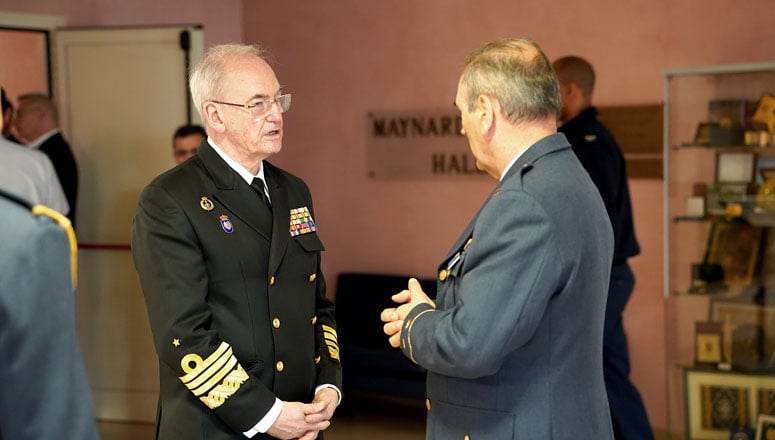
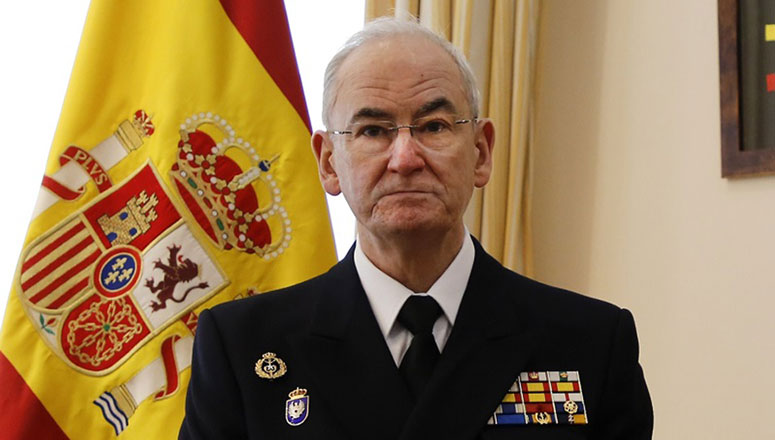
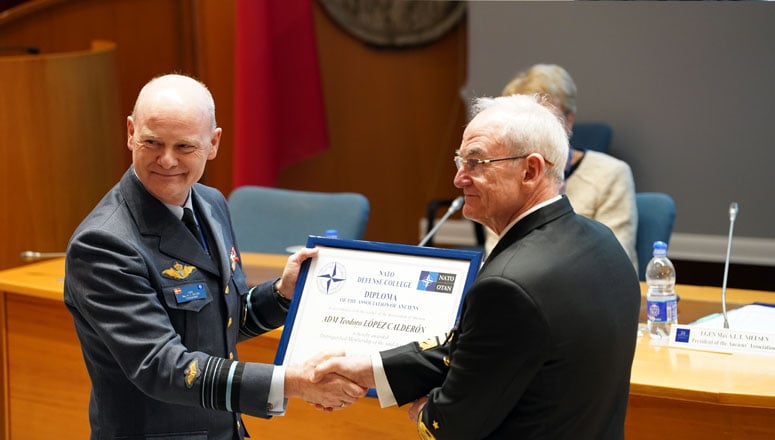
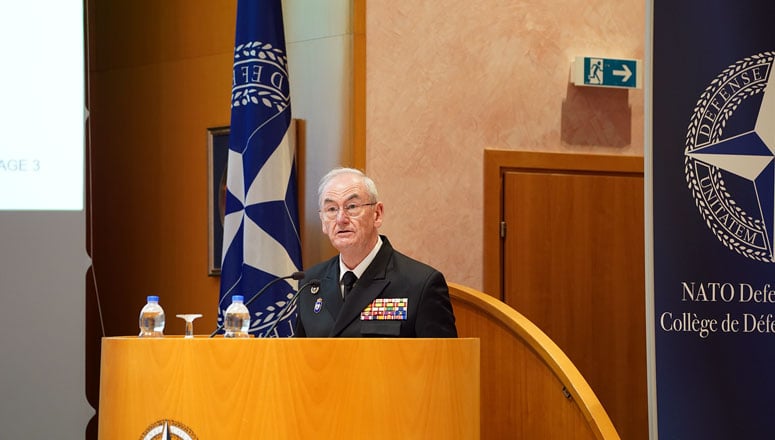
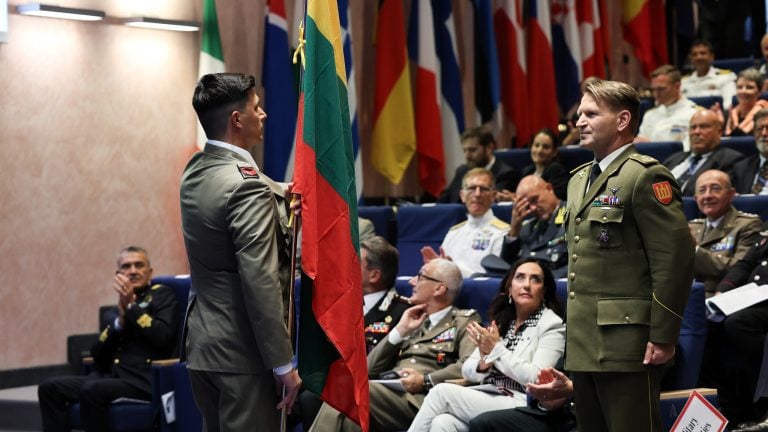
Admiral Teodoro Esteban López Calderón has served as Spain’s Chief of Defence since January 2021, after previously leading the Navy as Admiral Chief of Staff. His distinguished career includes commanding the Standing NATO Maritime Group Two and completing the NATO Defense College Senior Course in 1995. In May, he was honoured a Distinguished Ancien diploma at the 71st Anciens Conference & Seminar for his outstanding contributions to the Alliance. In this interview, the Admiral reflects on modernizing Spain’s defence capabilities, Spain’s evolving role within NATO, and his time at the College.

INTERVIEW
1) As Chief of Defence, what are your top priorities for modernizing Spain’s defence capabilities, and how do you plan to integrate emerging technologies, particularly in your role as Adviser to the Minister of Defence in his Technical Cabinet?
It is clear that the development, performance and future configuration of the Spanish Armed Forces must respond effectively and efficiently to the new and evolving global strategic scenario that is taking shape. This must be done in cooperation with our Allies, but without losing sight of Spain’s own autonomous defence requirements.
To improve and modernize our defence capabilities, I have focused my efforts on three main lines of action. The first priority is to ensure that the military capabilities currently available are adequately prepared for high-intensity combat, as their use may be required at short notice. As a second priority, we need to generate capabilities that are needed for today’s and tomorrow’s operating environments. Alongside these two priorities, and given the importance of “information superiority”, it is also essential to strengthen our capacity to collect, analyse and disseminate information.
These efforts will enable us both to increase our ability to deter our adversaries and to become more agile and decisive, thereby gaining the upper hand when confronted. Thirdly, as part of the ongoing transformation process, we must address continuous improvements that will further enhance our capabilities, taking advantage of new, emerging and disruptive technologies. This will enable us to achieve not only technological superiority and adequate interoperability with our Allies, but also confrontational superiority.
Moreover, all this must be based on what is known as multi-domain action, which, as you know, seeks to achieve the integration and synchronization of the actions of all state branches, in order to achieve all the necessary effects on the adversary.
2) Looking ahead, what role do you envision for Spain within NATO, and how can the Alliance strengthen its deterrence and defence posture?
Today, more than ever, the operational use of our forces abroad and our commitment to the Alliance are focused on the Alliance’s missions, primarily to deter Russia.
Spain contributes a wide range of capabilities not only to this mission, but also to other missions of deterrence and defence or stability projection, whether permanent or temporary. Spanish forces are present in many of NATO’s integrated air defence missions in Estonia, Latvia, Lithuania, Romania and Türkiye; in the deployments of the Permanent Naval Groups in the Mediterranean Sea and the Atlantic Ocean; and in the land deployments on the Alliance’s eastern flank, with forces in Latvia, Slovakia, where we are the lead nation in the multinational battlegroup and Warfighting Corps HQ, and more recently in Romania.
On Spanish soil, we host the Combined Air Operations Centre (CAOC) in Torrejon and have high-readiness land, maritime, air and special operations headquarters that periodically serve as NATO Component Commands. As can be seen, both in terms of the quantity and quality of personnel and capabilities made available to NATO, and in terms of the level of commitment, Spanish participation in the Alliance is very significant.
Spain has always been a reliable, secure and committed member of the North Atlantic Alliance and the values it represents and defends. Moreover, we intend to maintain this level of commitment to the Alliance and its deterrence and defence purposes in the future.
This commitment to deterrence and defence was reinforced by the implementation of NATO’s Strategic Concept 2022, adopted at the Madrid Summit. This document already underlined “the need to significantly strengthen our deterrence and defence as the backbone of our Article 5 commitment to defend each other”. It also sets out the guidelines to be followed to achieve this goal.
In my view, this needs to be complemented by a strong commitment and a clear message of unity among NATO Allies to reinforce the principles of the Alliance. This must go hand in hand with a clear defence of, and unanimous support for, Ukraine at this crucial time when the outcome of the conflict and its future as a country are being decided. This support, which should also be extended to other Alliance partners and allies in both the Indo-Pacific and the Southern Neighbourhood, will help us counter any interference or aggression.
However, all these efforts to strengthen our deterrence and defence will be in vain if they are not accompanied by a strong will to improve and update our military capabilities based on the new challenges and threats. This should be done, among other measures, through a digital transformation and the use of emerging and disruptive technologies, which will allow us to adapt quickly to the new domains and battlefields of the future.
Finally, we must strengthen the transatlantic link, which is indispensable to our individual and collective security. Only by strengthening our Alliance based on indivisible collective security, solidarity and a strong commitment to mutual defence will we achieve the credible deterrence and defence that will enable us to fulfil NATO’s primary objective of ensuring collective defence against all threats from all directions.
3) A key focus of the Senior Course is promoting interoperability and understanding the perspectives of different nations. In your earlier position within the South Atlantic Force, US Atlantic Fleet Command, along with other international and leadership positions, what do you consider essential in fostering effective communication across diverse military and cultural backgrounds?
A key focus of the Senior Course is promoting interoperability and understanding the perspectives of different nations in the Alliance. In my view, fostering effective communication can be built on five main pillars. The first is reliability. By this, I mean strictly delivering on what is said or committed to, being consistent in ensuring that what is offered is useful to the partner, and all this after listening to their needs or requests. The second is building respectful and personal relationships. Trust is a cornerstone of effective coalition operations. It is therefore essential to establish a relationship based on equal respect, without arrogance or superiority. It is also desirable to make time to connect personally, whether through shared meals, informal conversations, or joint activities, in order to build a rapport. Those relationships often outlast formal assignments and can be decisive during a crisis.
The third is listening with intent. Genuine listening, especially in cross-cultural groups, means being present and patient, noticing both what is being said and what is not. Silence, body language or hesitancy can carry different meanings in different cultures. You learn a lot by watching how someone communicates beyond just words. The fourth pillar is cultural awareness. Understanding that values, communication styles, and decision-making processes vary widely among nations is fundamental. Taking the time to learn the basics of your counterparts’ cultural norms, whether it is how they interpret hierarchy, handle disagreement, or express agreement, can dramatically reduce misunderstandings. Finally, the fifth is shared purpose and mission clarity. Keeping everyone aligned on the “why” of the mission creates a unifying focus. When individuals from diverse nations and services are clear on the collective objective, they are more likely to adapt and compromise in their approaches.
4) How how do you envision the role of the NATO Defense College in today’s security environment?
In the context of today’s security environment, the role of the NATO Defense College has never been more critical. In the face of today’s security challenges, the NDC’s mission must evolve to nurture leaders who can not only respond to crises but also anticipate them. We are no longer dealing with simple, linear threats. Today’s leaders must navigate a confluence of conventional, hybrid and cyber warfare while managing the complexities of disinformation, economic instability and internal political divisions.
I see the NDC’s role as twofold. Firstly, to continue shaping strategic thinking for future generations. The NDC must continue to serve as a think tank and incubator for strategic ideas. Its role as a forum for intellectual exchange – where military officers, diplomats and civilians from across NATO and partner nations can debate, analyse and challenge assumptions – is vital. NATO’s future leaders must be equipped not only with the skills to command forces, but also with the vision to lead complex coalitions and shape a global security order. You must also be a strategic visionary capable of seeing beyond the next crisis.
And secondly, to build resilience within NATO and the global security architecture. The NDC has a central role in ensuring that NATO remains agile and resilient in the face of an ever-changing landscape. It must teach leaders how to manage strategic shock, especially in the context of non-traditional warfare – the kind of warfare where adversaries exploit the vulnerabilities of societies, economies and political systems. The future of NATO depends on its ability to remain cohesive and adaptive, and the NDC is at the heart of fostering that understanding. Resilience – not just military, but also institutional, societal, and informational resilience – is the watchword for NATO’s leaders moving forward.
In essence, the NDC has always been and remains an anchor in NATO’s strategic landscape. The NDC’s ability to adapt its curriculum to those demands has been vital, and its role in shaping NATO’s future cannot be overstated.
NDC Public Affairs Office
(Prepared by Ms Britt Melinga, NLD C)
Next
 NATO Defense College