
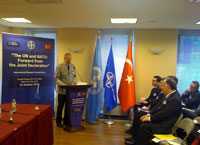
On 21 October 2010, in New York City, the Research Division of the NATO Defense College (NDC), with the support of the Permanent Mission of Türkiye to the United Nations, and in partnership with the Centre on International Cooperation (CIC) of the New York University, convened an International Research Symposium addressing “The UN and NATO: Forward form the Joint Declaration”.
The workshop brought together approximately 100 participants representing senior military officers, diplomats and officials from NATO (NDC/ACT/NAMA/C&RS/LNO), NATO Permanent Missions in New York, UN bodies (DPA/DPKO/DFS), the Russian Federation, EU and several Major Troop Contributing Nations to UN operations.
The Symposium was opened by H.E. Mr Ertuğrul APAKAN, Ambassador and Permanent Representative of the Permanent Mission of Türkiye to the United Nations. While positively welcoming the myriad of participants attending the event, the latter underlined the relevance of the Joint Declaration signed by the UN and NATO Secretariats in 2008, and noted that peacekeeping and peace building operations represent areas where the two organisations need to strengthen their cooperation. Ambassador APAKAN also drew attention to the imminent release of NATO’s new Strategic Concept which is expected to have implications for NATO’s relations with other international organisations.
Lieutenant General Wolf-Dieter LOESER, Commandant of the NDC, reaffirmed the importance of the College as “a NATO Think Tank” which provides critical policy research and analysis in the spirit of academic freedom. General LOESER also emphasized the relevance to the UN-NATO relationship of the branch of international relations theory called Inter-Organizationalism, highlighting its stress on regular dialogue to overcome differences as organisations increasingly overlap in crisis management mandates and tasks. General LOESER underscored that this was the central reason why the NDC convened the symposium in New York — to directly engage in open dialogue with UN officials and national representations to the universal organisation.
Lieutenant General Wolf-Dieter LOESER also held a press interview in the framework of the Symposium.
The keynote addresses were provided by General Stéphane ABRIAL, Supreme Allied Commander Transformation (SACT) and Prof. Lawrence S. KAPLAN, Georgetown University.
General Abrial underlined how the international community could benefit from strengthened UN-NATO partnership, given the increasing importance of civil-military cooperation in crisis management. SACT also laid down concrete proposals to enhance the UN-NATO partnership by inviting UN officials to NATO education and training establishments and centres of excellence.
In first describing the different origins of the UN and NATO in the 1940s, Professor Kaplan went on to draw attention to the increasing collaboration between the two organisations over the last two decades, spanning such places as the Balkans, Iraq, and Afghanistan. He concluded that “notwithstanding a contentious history, the potential for a mutually supportive relationship remains”.
Long and extensive Q&A sessions with subsequent panelists comprised of senior UN and NATO officials, and leading academics, ensued. Each exchange served to highlight further practical measures that could be taken to engender stronger collaboration between the two organizations for the maintenance of international peace and security.
LtCol. Mario Masdea, Chief Public Affairs and Protocol Officer, ITA-A
 Collège de Défense de l'OTAN


