
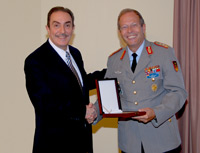
The Inauguration Ceremony for the NATO Regional Cooperation Course took place today at the NATO Defense College in Rome. The inauguration lecture was delivered by H.E. Ambassador Dr Omar RIFAI, President of the Jordan Institute of Diplomacy.
His Excellency and the other distinguished guests were welcomed by the Commandant of the NATO Defense College, Lieutenant General Wolf-Dieter LOESER.
During his opening remarks the Commandant underlined the aim of the course, which was not to put forward national positions, but to understand each nation’s viewpoint and to build bridges among countries. Lt General LOESER highlighted the fact that the broader Middle East and NATO countries share issues of mutual interest and that events in the Middle East and in the Gulf Region matter to the Euro-Atlantic area, and vice versa. The key to success for the Alliance and to a safer global environment lies in the common effort to understand one other better.
The visit of H.E. Ambassador Dr Omar RIFAI offered the opportunity to strengthen practical cooperation and joint outreach activities with the Jordan Institute of Diplomacy, as a follow-on to the Commandant’s visit to Jordan in March 2010. Furthermore it allowed room for the planning of a possible visit and lecture by Lt General LOESER at the Jordan Institute of Diplomacy at the end of this year.
The NATO Regional Cooperation Course offers Course Members the possibility to study and analyse at a strategic political-military level the security issues concerning the broader Middle East and its relationship with NATO. The aim of the course is to link issues of concern both to MD and ICI nations and to NATO, and to develop mutual understanding and networking among participants.
NRCC-4 consists of 27 Course Members from 16 NATO, MD and ICI countries.
The course is held twice a year and was developed in response to the decision by the Alliance Heads of State and Government at the Riga Summit in November 2006 to foster a deeper dialogue and cooperation in education among MD and ICI countries and NATO.
In 2009 the first course was held and the new program generated high interest. Since then, the Middle East and Gulf States have been encouraged to develop a better knowledge of NATO, while the Alliance, on its part, has committed itself to studying and gaining a greater understanding of the issues and the specificities of this complex region.
NDC Public Affairs Office
(Prepared by Ms Valerie Kasseckert, DEU C)

 Collège de Défense de l'OTAN