
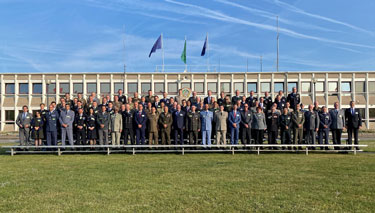
Field Study 2 for Senior Course 140 officially began on 3 May 2022.
The first day in Belgium was dedicated to a visit and briefing at Supreme Headquarters Allied Power Europe (SHAPE) in Mons
Course Members were welcomed by Gen. Sir Tim Radford, the Deputy Supreme Allied Commander Europe (DSACEUR).
General Radford thanked the NATO Defense College for this first visit in three years (the last visit was in November 2019), and remarked the importance of cohesion within the Alliance, especially during times of trouble.
Following his speech, DSACEUR took part in a Q&A session, which focused primarily on the Russian invasion in Ukraine and NATO’s multi-domain approach.
A classified briefing about Defence and Deterrence Activities (DDA ) and implementation was provided to Course Members from NATO countries, followed by an unclassified briefing on strategic thinking that was presented to Course Members from both NATO and partner countries alike.
A Q&A session followed both briefings.
Next, Col. Frank Düwel (DEU A), Deputy Director of CCOMC, gave a briefing on NATO Current Operations, Enhanced and Tailored Forward Presence, in the Baltic area; deterrence actions; and NATO support to the African Union, which has been ongoing since 2007 in terms of operational, logistical and capacity-building support.
The next briefing, presented by the J7 Division, was about training and exercises. The briefer highlighted their importance for deterrence, increasing proficiency, and developing interoperability. He then presented the training plan for the upcoming years, and shined a spotlight on exercise Steadfast Jupiter, the most significant annual exercise within NATO.
The last briefing of the morning session was presented by Mr. Gilen Brolon, from OACM, who gave the Senior Course an overview about NATO Command Structure (NCS) and SHAPE roles and responsibilities.
The briefer emphasized how NATO is adapting NCS to future challenges, and rebalancing ACO/ACT roles and responsibilities in order to increase the peace establishment.
Questions and Answers sessions followed all briefings.
At the end of the morning session, closing remarks were made by MGEN Karol Dymanovski (POL A), DCOS SDP (Strategic Development and Preparation), in which he stressed the importance of cooperation with partner countries.
The Dean of the NDC, Dr. Christopher M. Schnaubelt, concluded the morning session at SHAPE by thanking MGEN Dymanovsky for the hospitality and the presentations provided.
The second half of the day was dedicated to a visit of the European Union Commission, where several briefings were presented.
Following a welcome address by Ms. Nicole Pile, Mr. Rüdiger Boogart, Secretariat – General, presented a briefing on the six priorities and current work program of the president of the European Commission, Ursula Von der Leyen. The priorities are: the Green Deal, Digitalization, Artificial Intelligence, Quality of Employment, EU Defence, Internal Security, Protection of Democracy and Partnership The COVID-19 pandemic and the Russian invasion were also discussed.
An introduction to the EU Strategic Compass: A Strategic Overview of Challenges and Threats was presented by Ms. Agnieska Bazanska-Madej, from the European External Action Service. She focused on EU initiatives about improving rapid deployment capacity and conducting exercises; strengthening Europe’s command and control structures; increasing naval presence; countering cyber threats and disinformation campaigns; improving investments in defence; and increasing partnerships with NATO, Western Balkans, Eastern and Southern partners.
The following briefing by Mr. Panagiotis Giannakoulias, from Division Partnerships and the NATO – EEAS Task Force focused on EU-NATO relations history and cooperation. The Warsaw Joint Declaration, signed on 2016 by President of EU Council and EU Commission and Secretary General of NATO was the first document in which 7 key areas of common interests were determined. The second document was the Brussels Joint Declaration, signed in 2018. The two Joint Declarations provide a solid and comprehensive framework and a substantial cooperation agenda.
The briefer highlighted the importance of strategic EU-NATO partnership for Euro-Atlantic Security, as has been demonstrated since the Russian invasion of Ukraine.
In the subsequent presentation, led by CAPT Hans Huygens from EUMS (EU Military Staff) and Ancien of SC 123, EU-NATO cooperation was discussed from the military perspective, along with the NATO 2030 conclusions given at the NATO 2021 summit.
A warm reception then followed, which organized by Admiral Rob Bauer, Chair of the NATO Military Committee, and Admiral Michel Hofman, Aid-de-Camp to the King, Chief of Defence, in the wonderful location of Val Duchesse, Auderghem, to conclude a most productive 1st day in Brussels.
NDC Public Affairs Office
 Collège de Défense de l'OTAN