
Second day in Brussels as part of Field Study 2 for Senior Course 140.
Today’s session, hosted by the Belgian MoD, started with an introduction by Col. (BEL A) Luc Mees, staff member and Belgian Senior National Representative (SNR) at the NATO Defense College, who moderated discussions.
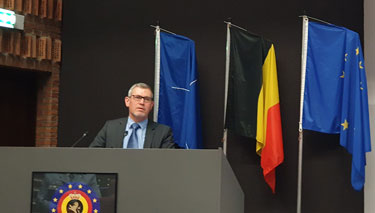
Next, LGEN Marc Thys, Deputy Chief of the Belgian Defence, gave an introductory briefing in which, after welcoming the delegation, he provided an overview of Belgium’s defence budget, explaining how expenditure had evolved over recent years in terms of collective security, expeditionary and collective defence as well as warfighting, and providing a trend analysis.
MGEN Frederik Vansina, Assistant to the Chief of Staff, subsequently gave a very detailed presentation on Belgium’s defence policy. Having started with an historical perspective and an overview of the European security environment, he turned his attention to domestic security, including the terrorist threat and how the country’s defence policy needed to be adjusted in order to counter the threat effectively.
General Vansina then outlined Belgium’s 2030 targets, highlighting budget expenditure, long-term investments, improvements to dual-capability systems, cyber defence, and underlining the importance of investing in a dedicated cyber component.
The briefer went on to inform SC 140 Course Members on how Belgian defence is supporting partners and stakeholders, in particular NATO and the EU, notably as part of ongoing work on the Strategic Compass and on the development of an EU Rapid Deployable Capability. Moreover, Course Members heard how Belgium is consolidating and enhancing its role internationally in support of the UN, through participation in peacekeeping operations, and in the multinational field, through support for BENELUX defence cooperation, as well as with bilateral cooperation with countries in Africa and the Middle East.
The session continued with a presentation by the Belgian Permanent Representative to NATO, Ambassador Pascal Heyman, who highlighted the Belgian contribution to NATO and noted how the Russian invasion of Ukraine had strengthened the Alliance.
MGEN Vansina then presented a briefing centred on the three main current defence challenges for Belgium, i.e. increasing readiness of forces, adapting to the new digital operational environment and restructuring as necessary to manage a growing organization.
A Q&A session wrapped up the day’s morning programme, with the discussion focusing chiefly on the Russian invasion of Ukraine, the challenges emanating from China and the cyber domain, as well technological development.
In the afternoon, a guided tour of the Waterloo battlefield which had been especially organized for the delegation concluded the academic programme for the day.
NDC Public Affairs Office
 Collège de Défense de l'OTAN