
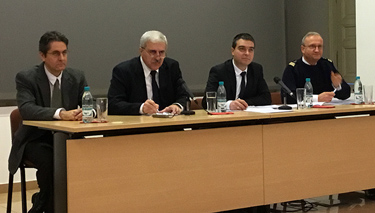
For the first stop on its third and final field study, Senior Course 131 met the Bulgarian authorities in Sofia and received different briefings. On December 12, Course Members met in the facilities of the Bulgarian Military Academy. On that day, two NDCs met. The SC131 was warmly welcomed by Major General Grudi Ivanov Angelov, Commandant-Rector of the National Defence College (first NDC), who explained the role of his College in the Bulgarian Armed Forces. He also thanked the NATO Defense College (the second NDC) for the visit and for the high educational standards set by its courses in Rome.
Following this introduction, Mr Liubomir Ivanov and Mr Jordan Parvanov, both from the Ministry of Foreign Affairs, discussed Bulgaria’s foreign relations. Mr Parvanov underlined the relationship between the eastern and western Balkans and the relationship with Turkey, especially regarding the fight against terrorism. He also spoke about EU membership, the visibility of Bulgaria in the EU and the importance of EU-NATO cooperation. After him, Mr Ivanov focused on NATO and discussed the importance of the Black Sea region and the different NATO missions for Bulgaria. He was then followed by Mr Vladimir Spassov, representing the Ministry of the Economy. He gave Course Members an overview of the economic indicators of Bulgaria, which included interesting and positive figures about employment and GDP growth. He then explained the country’s economic policy, based mainly on achieving high economic growth and sustaining it – for example, through support to high-tech industry. The representatives of the Ministries of Foreign Affairs and the Economy answered Course Members’ questions after their briefings.
After a short coffee break, Col Ventsislav Vassilev from the Defence Policy Directorate in the Bulgarian Ministry of Defence took the floor and explained the future development of the Bulgarian Armed Forces. He dealt mostly with three topics, based on possible future security situations: capability development in relation to technology; NATO and the EU transformation, and the consequences for Bulgarian security policy; and, finally, civil-military cooperation, the comprehensive approach, crisis management and resilience.
He was followed by Col Ivan Varbanov from the Strategic Planning Directorate of the MoD. He explained the structure of the Armed Forces and gave some details of capability development. Among all the improvements referred to, he dwelt on those in the mechanized brigade and the acquisition of new combat aircraft. He also identified the relationship with the current operations of NATO and EU as the driving force for modernization. He ended his presentation with an appraisal of the regional partnerships which represent an important part of the Bulgarian Armed Forces’ effort for stability in the Balkan region.
Commander Dimitar Jordanov, from the Operations and Training Directorate was the last to take the floor. He presented the Bulgarian contributions to international operations. He underlined the contributions in fighting terrorism and also the measures taken to mitigate the consequences of massive immigration flows. In the second part of his presentation, he spent some time to give some results of the “Noble Jump” exercise, which was successfully conducted with Bulgaria as host nation. He also spoke about the exercises in 2017 in the Black Sea and in 2018 in the Norway area, and finished his presentation by speaking of the main training range in the region and the country’s well developed modelling and simulation capabilities .
After this last presentation, the speakers took part in a panel discussion, moderated by Navy Capt Paul Gelly, French Faculty Adviser at the NDC.
NDC Public Affairs Office


 Collège de Défense de l'OTAN