
For the Study Period on NATO in Transformation Part 1, held from 5 to 9 October, Senior Course 115 were joined in the auditorium by the Integrated Partner Orientation Course (IPOC), comprising 17 participants from 13 countries; the “Modular Short Course”, consisting of 9 military and civilian participants from 6 NATO countries; and the NATO Regional Cooperation Course, consisting of 20 Course Members from 13 different countries. The main objective of this Study Period is to give Course Members solid background knowledge on NATO and its development before they depart for the Autumn Field Study, which includes visits to the NATO Headquarters in Brussels, Allied Command Operations (ACO) in Mons and Allied Command Transformation (ACT) in Norfolk.
The week began with a panel lecture on the “The Transatlantic Link”, delivered by Ambassador Marc GELEYN, from Belgium, and Mr Stan SLOAN, who each presented a different perspective on the topic. The two lectures provided a brief historical outline of the disagreements within the transatlantic relationship and their implications on both sides of Atlantic, though it was stressed that NATO is strong and adaptable enough to survive any crises in the foreseeable future. The common security agenda, the potential consequences of cooperation, and the challenges that Allies may have to encounter in the coming years were covered in detail. The audience received updated information on the current status of transatlantic relations, with the emphasis on recent developments. Within this context, the new US administration, the global financial crisis, Russia, WMDs, French re-integration into the NATO military structure and the importance of NATO-EU cooperation were discussed.
In an inspiring lecture, Mr Joris GHESQUIERE, Head of Plans and Policy Branch at NATO Headquarters, proved once again that “NATO Resource Policy” need not be a dull or arid subject. He explained in detail the various forms of funding – national, multinational, joint and common – and their impact on the Alliance, and described the contemporary challenges that NATO must overcome for the success of the Alliance and its current operations. He also provided exhaustive information on Trust Funds and outsourcing, arguing that increased common funding would reinforce Alliance cohesion.
Mr Bruce BACH, Defence Policy and Planning Division, NATO HQ, lectured on “NATO Defence Planning and Defence Structures”. In his presentation, which was an excellent scene-setter for the upcoming NATO Field Study, Mr Bach concentrated on the ongoing issues that revolve around current NATO defence planning and structures. He pointed out that defence planning is a vital function within the Alliance and one that keeps Allies focused through the common process used to address a range of challenges. He emphasized the need for realistic planning, given the limited resources available and the current political situation, and highlighted the fact that the establishment of command structures, force planning and capabilities is the result of a political process and depends on the will of the nations.
The Study Period continued with a lecture on “NATO Transformation” by RearAdm Jørgen BERGGRAV (NOR/N), SACT’s representative in Europe, and Dr Hennig Riecke, Head of the European Foreign and Security Policy Program at the German Council on Foreign Relations. Both speakers gave very informative lectures on the current status of transformation, including a conceptual overview and an analysis of the current challenges and issues arising from the transformation process. NATO, it was asserted, has always been an adaptable organization but needs to acquire capable forces and capabilities in order to keep abreast of the current security environment.
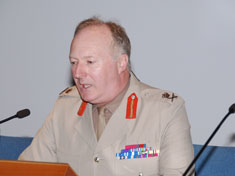
The highlight of the Study Period was the lecture given on Friday 9 October by Lt General Jonathan Riley, previous DCOM ISAF, UK Army, on the “The Strategic Challenges of Current NATO Operations”. His outstanding presentation, touching on all aspects of the situation in Afghanistan, including internal social, economic and political problems, reflected his experience in that theatre and provided a candid and personal analysis of the strategic challenges faced by NATO troops today. He underlined the importance of the comprehensive approach, while stressing that the development issue was a crucial one and that the role of Provincial Reconstruction Teams in this regard was vital.
Overall, this was an extremely inspiring and stimulating week, full of topical, challenging issues and interesting discussions.
NDC Public Affairs Office

 Collège de Défense de l'OTAN