
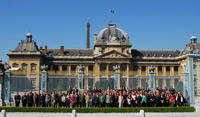
PARIS- The NATO Defense College Senior Course 117 enjoyed a highly informative and certainly memorable visit to the l’École militaire in Paris, France. Beyond the renowned cultural experiences and team-building enjoyed by each committee, the highlight of the visit was the five distinguished speakers arranged for the visit, each of whom shared valuable personal insights and instructive French perspectives with the Course Members of SC117.
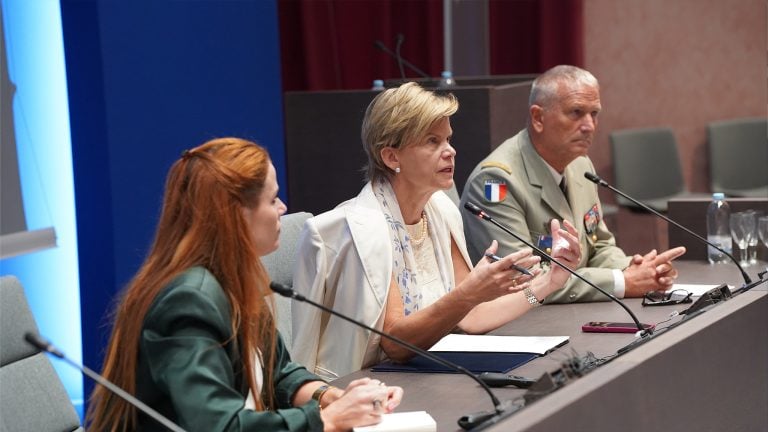
In his opening remarks, Major General Jean-Jacques BART, Deputy of the Joint Staff’s International Relations Division, discussed the implementation of France’s full participation in the NATO command structure, a decision announced at the 2009 summit in Strasbourg-Kehl. He also highlighted several budgetary challenges facing France and the Alliance, stemming from the global financial crisis and obviously shaping resourcing strategies for defense reforms, current operations, and NATO’s budgetary governance.
Colonel Michel FRITSCH provided an in-depth analysis of France’s significant role in the Alliance. France has been solidly committed to the Alliance since NATO’s founding days, and it remains as actively engaged in NATO’s current operations and future strategic purpose as it was more than 60 years ago. This important context set the stage for two subsequent briefings on French foreign policy and the country’s current global commitments.
Brigadier General Patrick LEFEBVRE provided Course Members an overview of current operational commitments and the French decision making process that authorises current operations. His frank and relevant remarks were enabled by his current appointment as Executive Assistant to the Chief of Defence Staff, combined with his expertise as former Chief of Operations in the Centre de planification et de conduite des opérations (CPCO), on the Joint Staff. He highlighted France’s significant military commitments abroad, current operational priorities, and future strategies for garnering efficiencies and generating synergy of capabilities.
The final briefing on French foreign policy was delivered by Mr. Maxime LEFEBVRE, a project leader in the Ministry of Foreign and European Affairs. Mr. Lefebvre first highlighted the traditional pillars of French foreign policy, based on its history as a strong Western democracy, a leader of European integration, and a known power with global influence. He then explained how this continuity has endured changes over time, concentrating on President Sarkozy’s role in shaping current policy.
The lectures were followed by extensive Q&A periods, during which the Course Members of SC 117 presented challenging and salient questions to their hosts. The briefings ended with a lunch reception in the Rotonde Gabriel de l’École militaire, hosted by Vice-Admiral Phillippe COMBES, Chief for International Relations, French Joint Staff. The Admiral shared his thoughts on the approaching Lisbon summit and the importance of NATO’s new strategic concept. The course members also enjoyed a moment of camaraderie with their French hosts, marked by the splendid reception that ended the visit to the École militaire. Lieutenant General Wolf-Dieter LOESER, the Commandant of the NATO Defense College, thanked the Admiral for his remarks, and also thanked him and his entire staff for making the visit such a rewarding experience.
The next stage of the European Field Study takes the Course to London, followed by Berlin, Copenhagen, and Sarajevo.
NDC Public Affairs Office

 Collège de Défense de l'OTAN
