

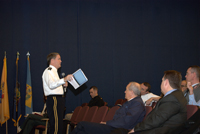
On 7th November, Senior Course 121 (SC 121) visited the Henderson House in Washington, DC.
The group was welcomed by Mr James J. Townsend Jr., Deputy Assistant Secretary of Defense for European and NATO Policy. After some brief introductory remarks on his responsibilities, Mr Townsend spoke briefly of the US presidential election. With the result still in the balance so early in the day, he outlined possible implications (for NATO and its partner countries) of a Democrat or Republican victory: any change in the leadership of the executive power, such as the arrival of a new Secretary of State or Secretary of Defense, inevitably leads to different or adjusted visions and strategies in US security policy. The speaker then went on to discuss possible future scenarios for US-EU relations. This first talk of the day was followed by a challenging Q&A session, covering the influence of the defence industry on Department of Defense policy, relations with the EU, and the limits to NATO enlargement.
Lieutenant General Terry Wolff, Director Strategic Plans and Policy J-5 Joint Staff, was the following lecturer. He briefed Course Members on the areas of responsibility of the US armed forces and the key tasks the Joint Chiefs of Staff have to address. Priorities are: sustained action against al-Qaida, the transition of Afghan security to the Afghan National Security Forces, prevention and mitigation of the effects of cyberterrorism, and the expansion of both interagency and international cooperation. The General engaged Course Members in an intense Q&A session, in which the most important issues discussed were China’s strategic position vis-à-vis the US and the possible consequences of the 2020 Scenario for the US strategy development process. Other interesting topics of discussion were the effect on NATO and European policy of the US shift toward the Asia-Pacific region, and the role of the United States in Libya.
The third briefing of the morning was delivered by Brigadier General Maryanne Miller, Deputy Director for Partnership Strategy of the Joint Staff. The theme of the General’s presentation was “Building Partner Capacity” (BPC). She briefed SC 121 on the purposes, policy evolutions and challenges of the process of synchronization with other US federal Agencies, illustrating in detail how this process is carried on. The Q&A session afforded an excellent opportunity to discuss the prioritization of partnerships, with specific questions on the relationship between US ambitions and the current NATO partnership agenda, as well as on synchronization with the industrial sector.
More about the Field Study:

 Collège de Défense de l'OTAN