

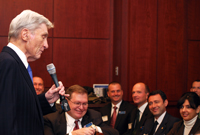
On Tuesday 6th November 2012, Senior Course 121 (SC 121) was in Washington, DC. The group visited Capitol Hill in the morning, and the US Institute of Peace (USIP) in the afternoon.
Course Members were welcomed to Capitol Hill by Brigadier General Rudder (US MC), Legislative Assistant to the Commandant of the US Marine Corps (USMC), who gave a short introductory briefing. Brigadier General Rudder described the way the defence structure at Capitol Hill interacts with the political-legislative branch. An important factor in this respect is the process of creating a “shared understanding” between the representatives of the armed forces and the Armed Services Committee (ASC) of both the Senate and the House of Representatives. The speaker also reviewed several possible consequences of the US foreign policy reorientation in the Asia-Pacific region, for the armed forces in general and for the USMC in special.
The second briefing of the day was provided by Mr Don Richie, historian of the United States Senate. Explaining the historical origins of the Senate’s influential position in the country’s civic life, Mr Richie helped Course Members appreciate the finer points of the US congressional system. Finally, he offered some fascinating background on the history of the building itself.
Mr Bill Monahan, counsel for the Senate ASC, was the following speaker. He explained the composition of the ASC, which consists of 26 Senators: this means that more than a quarter of US Senators are part of the Committee, reflecting the importance of security in US national politics. Mr Monahan continued with the description of three main questions on which the ASC updates and advises the Senate – the annual defence budget, policy implementation, and promotion of senior military officers. However, the most important role of the ASC today is to ensure that the rebalancing of US forces and cuts in the defence budget are guided by a clear and comprehensive strategic vision. This talk was followed by a lively Q&A session.
A highlight of the morning spent on Capitol Hill was the briefing by Senator John Warner. He underlined the importance of NATO membership for the United States, which is thus firmly bound to an Alliance of 28 like-minded nations brought together by their shared democratic values and by a pledge to defend each other. Senator Warren also commented on NATO’s unique status as the most long-standing and successful military coalition ever, arguing that it should focus on its original role with no further engagement in out-of-area operations or in new spheres of activity. The ensuing Q&A session was purposeful and thought-provoking, with specific questions from Course Members on Iran’s nuclear posture, current events in Syria, and the partnership with Russia.
The last briefing of the morning was provided by Mr Bob Simmons, Staff Director at the House of Representatives ASC. He spoke about the 2013 Defense Bill and the outcomes it is intended to achieve. He also answered questions on the US position vis-à-vis the Russian Federation and on the global security situation as a whole, including some remarks on Iran and Syria.
In the afternoon SC 121 visited the USIP. Mr Paul Hughes, USIP Chief of Staff, welcomed the group and introduced the Institute’s thinking on three main concepts: Conflict Management, Peace Building and Drivers of Conflict.
Colonel Eric Wesly of the National Security Staff then took the floor. He focused on Afghanistan and Pakistan, with particular reference to the NATO and US exit strategy regarding military organization, transition, reconciliation, and enduring commitment in the region.
The final briefing of the day was given by Mr Michael Lekson and Mr Brian Rose, who spoke about the nuclear issue. They discussed proliferation of nuclear material and the current status of the Non-Proliferation Treaty. The concept of nuclear balance was highlighted, with an impartial comparison of the intentions expressed in this regard by both sides during the US presidential campaign (the outcome of the election being just hours away at the time of the visit). As a busy conclusion to a very informative session, Course Members had the opportunity to ask for further detail on a number of topics during the keenly awaited Q&A session.
More about the Field Study:

 Collège de Défense de l'OTAN

