
On Monday 9 December 2013, Senior Course 123 (SC 123) began its Regional Approaches & Partnership for Peace (PfP) Field Study in Ljubljana, Slovenia.
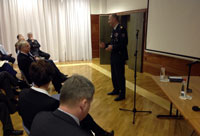
On arrival, the NDC delegation had the opportunity en route to the Ministry of Defence to admire this small but beautiful European capital. Course Members were then welcomed to the Ministry of Defence by MajGen Dobran Božič (SVN A), Chief of the General Staff of the Slovenian Armed Forces (SAF). During the visit, NDC Dean Dr Daria Daniels Škodnik (SVN C) and Brig Gen Venčeslav Ogric (SVN A), Chief of the Military Education Centre, spoke about possible future cooperation between the two institutions.
This first day was concluded by a visit to the Slovenian Parliament, where the NDC delegation had a joint meeting with Mr Matjaž Zanoškar, Deputy Chair of the Parliamentary Group for Defence, and Dr Jožef Kunič, Deputy Chair of the Foreign Policy Committee. Dr Kunič spoke about Slovenia’s achievement in fulfilling NATO and EU membership requirements within little more than a decade of independence. On defence, Mr Zanoškar stressed the level of popular consensus regarding the participation of Slovenian armed forces in missions around the world (e.g. Kosovo, the Mediterranean area, Afghanistan) and the extent of Slovenia’s commitment towards NATO. These briefings were followed by a very stimulating Q&A session.
On Tuesday 10 December, MajGen Božič welcomed Course Members back to the Ministry of Defence for further briefings.
First, Mrs Dragoljuba Bencina, Director General for Global Issues and Multilateral Political Relations at the Ministry of Foreign Affairs (MFA), spoke about Slovenian foreign policy priorities. She underlined the importance Slovenia attaches to engaging with neighbouring countries in the human rights field, particularly with regard to the situation of ethnic groups. Substantial resources are dedicated to human rights, with humanitarian and development projects in Kosovo and active support to the United Nations in this sector. The speaker also commented on the presence of Slovenian minorities in various countries like Italy and Austria. For peacekeeping missions and bilateral agreements, Slovenia’s leading partner is Italy.
Mr Andrej Slapničar, Minister Plenipotentiary, Head of the Security Policy Department (MFA), then briefed the group on three aspects of Slovenian foreign policy: NATO, the EU and arms control. In a few months, Slovenia will celebrate ten years of NATO membership, and the national Parliament is currently discussing involvement in Afghanistan after 2014. The speaker explained Slovenia’s need to work with partners in strategic fields, such as maritime security and cyber security. Slovenia is involved in many missions, coordinated both by NATO and EU, including the EU’s civil protection mission to Lebanon and training mission to Mali. In addition, Slovenia is active in providing assistance to mine victims in the Balkans.
The next speaker was Mr Primož Šavc, Director General, Defence Policy Directorate, Ministry of Defence. He focused on the challenges and opportunities of Slovenian defence policy, including defence cooperation initiatives led by Italy and by Austria. These initiatives underline the strategic geopolitical position of Slovenia, situated as it is on NATO’s south-east flank. Mr Šavc also analysed the flow of investments in the defence sector: while these decreased from 1.65% in 2010 to 1.2% in 2012, an upturn is scheduled from 2016 on. Future objectives are: honouring international commitments despite financial cuts, maintaining credibility as a NATO and EU member, and ensuring a close focus on regional defence cooperation in the next few years.
Col Ivan Mikuž (SVN F), Deputy Chief of Staff for Strategic Planning, then analysed SAF capabilities. He started with historical data spanning the two decades since independence, before focusing on the personnel structure of the SAF. Main goals for the future are: to ensure a lighter, more flexible, more territorially oriented organization; and to rationalize the number of commands. Participation in missions will be reduced by 10-16% over the next year, while a number of Smart Defence projects will be carried forward.
The final briefing was by Mr Zijad Bećirović and Mr Bakhatyar Ajaf, from the International Institute for Middle East and Balkan Studies, who addressed Course Members on the topic “The Balkans and the Middle East: Challenges and Solutions”.
All the briefings were followed by lively Q&A sessions, allowing a specific focus on several aspects of Slovenian defence and foreign policy, as well as on the NATO-Slovenia relationship.
This second day in Ljubljana marked the conclusion of SC 123’s visit to Slovenia. Course Members now travel to Athens, for institutional meetings with the Hellenic authorities.
NDC Public Affairs Office

 Collège de Défense de l'OTAN


