
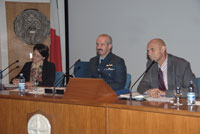
In the week after the return from the “TRANSATLANTIC LINK” Field Study, Senior Course 115 engaged in the 11th week of the academic programme with Study Period (SP) C1 – “Global Security Challenges” . The aim of the SP is to analyze global security challenges and the possible implications for NATO. The NRCC (NATO Regional Cooperation Course) and, for the first time, the NEDP (NATO Executive Development Programme) joined with SC Members to attend the first week of lectures.
Earlier in the Course, SC 115 had the opportunity to propose a vision of the world in 2025, outlining the future security environment within which NATO must work. SP C1 provided the chance to hear from experts in a number of specific fields to further inform committee views. At the end of the SP, committees have the opportunity to identify, by consensus, the topic deemed most relevant to NATO, and develop recommendations – as though advising, perhaps, on an element to be included in the new NATO Strategic Concept. The extensive lecture content of SP C1 was as follows:
Monday 9 November, “Resource Scarcity and Water”, was presented by Dr Theresa Sabonis-Helf (USA), who is a professor at the National War College in Washington, DC. Dr Sabonis-Helf covered the causes of resource scarcity and the need to think strategically about resources, emphasizing the need for governance with respect to resource allocation. The problems of water scarcity, aligned with the unsustainable use of water, were a key theme.
On the same day Mr Jan Delbaere ( Belgium), a high level expert and experienced operational practitioner from the United Nations World Food Programme (UN/WFP), Rome ( Italy), provided analytical insight into the “Food Security”. Mr Delbaere offered a 3 point framework within which to view the issue: Availability, Access and Utilisation of food. Mr Delbaere provided a good analysis of the interdependent relationship of cereal production and livestock for the human food chain, and developed the long term consequences of malnutrition in societies, leading to insecurity for the future.
On Tuesday 10 November a lecture on “The Environment and Consequences of Climate Change” was presented by Professor Gwyn Prins – first Alliance Research Professor appointed from 2002 jointly at the London School of Economics and Columbia University in New York, and NDC Ancien. Professor Prins provided a critical view of the forthcoming summit in Copenhagen as well as a broad overview of the politics of climate change. Profesor Prins succinctly covered the means available to states to achieve carbon reduction, linking it critically to state energy policy.
On the same day Dr Nazrin Mehdiyeva presented the lecture “Energy Security”. Dr Mehdiyeva is a leading energy consultant providing strategic, commercial, regulatory and policy advice to Europe’s energy markets. Dr Mehdiyeva offered a valuable definition of energy security and a detailed analysis of the issues associated with gas supply to nations, particularly in times of crisis. The link between energy security and national policy in other areas was well argued.
On Wednesday 11 November “National Identity and Pluralism” was presented by Professor Palmisano, from the University of Trieste. Professor Palmisano covered various ways to analyse the current global situation: he mentioned that global actors were almost as powerful as states, that there was a multiplication of actors within states, and offered a simple 3 point perspective of the basis for order in society: blood ties, territory and vision. He provided many illustrations of the multiple identities and allegiances actors make take depending on the situation – “Situational Identity” – as the Professor described it.
Thursday 12 November “Demography and Migration” was delivered by Professor Peter Liotta ( USA), Professor of Humanities and Executive Director of the Pell Center for International Relations and Public Policy at Salve Regina University, Newport, Rhode Island, USA. As a member of the United Nations Intergovernmental Panel on Climate Change (IPCC), Professor Liotta shares in the 2007 NOBEL PEACE PRIZE. He gave a comprehensive presentation covering a variety of issues, including long-term global demographic trends. He developed the concept of “entangled vulnerabilities” as well, and offered numerous examples of demographic and migrational pressures on states.
On Friday 13 November a lecture on “Terrorism” was delivered by Dr Edwin Bakker, from the Clingendael, who offered a useful discussion on the definition of terrorism and provided a valuable academic perspective on key issues including examples of recent concrete successes against terrorism, but also developed the argument of terrorism’s increasing lethality.
On the same day, Col Aytac,from the Centre of Excellence for Defence AgainstTerrorism (COEDAT),an institution based in Ankara, offered a complementary and additional perspective on terrorism, introducing a useful discussion on the role of the media in terrorist thinking. Together with Dr Bakker, Colonel Aytac focused Course Members’ thoughts on the key relevance of terrorism and its possible implications for NATO.
On Monday 16 November “Organised Crime” was presented by Mr Calvani, from the United Nations Inter-regional Crime and Justice Research Institute (UNICRI). Mt Calvani provided a fascinating overview of international crime, criminality and criminal hierarchies, covering various specific elements of international crime, such as people trafficking and drugs smuggling, and stressed the view that lack of international governance faciliated much transnational criminal activity.
On the same day Mr REULAND, from Interpol, complemented discussions with his lecture on Organised Crime from an Interpol perspective. Mr Reuland offered useful thoughts on possible NATO roles in fighting international crime, specifically piracy and apprehension of war criminals, and covered the main elements of Interpol’s endeavours and limits. Mr Reuland summarised with interesting suggestions on NATO/Interpol complementary action.
On Tuesday 17 November, the Study Period concluded with Professor Dr Holger Mey ( Germany), political analyst and head of Advanced Concepts, EADS, Munich, Germany, with a lecture on “ Weapons of Mass Destruction, Proliferation and Arms Control ”. Professor Mey offered a fascinating and thought provoking analysis of the key issues, challenging Course Members to engage in ‘proper differentiation’ of the conventional assumptions on deterrence.
On the same day, and as the final lecture, Mr Ted Whiteside, Secretary of the North Atlantic Council and NDC Ancien, offered his views on the topic. Mr Whiteside provided a masterly overview of the political issues inherent in any discussion on WMD and proliferation, including missile defence. Mr Whiteside provided ample food for thought for the following Question and Answer session.
Throughout the seven days of “Global Security Challenges” Course Members engaged in lively “Question and Answer” sessions, held committee debates, and worked towards the completion of a consensus paper. SP C1 is busy, but worth all the effort.
NDC Public Affairs Office
 NATO Defense College