
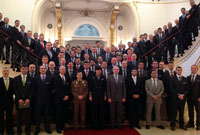
On Saturday 14 December, Senior Course 123 (SC 123) moved to Hungary, the capital Budapest being the fourth stop on the Regional Approaches & Partnership for Peace Field Study.
On Monday 16 December, the group was hosted at the Stefánia Palace for a busy day of briefings, the opening address being given by Col Jenö Ladocsi, Branch Head of the Operational Directorate – J3 .
A number of enlightening and thought-provoking briefings followed. Mr Tas Kelemen, Head of the Defence Policy Department , spoke about “The Security and Defence Policy of Hungary”. The audience was introduced to some figures about the country’s current economic growth, followed by a specific focus on Hungary’s defence policy and its strong commitment to NATO and EU.
The indivisibility of the transatlantic area’s security was also emphasized. This concept was examined in relation to national defence, with its two basic pillars: sovereign national force and Allied cooperation. On the one hand, sovereign force is essential to the fulfilment of Hungary’s constitutional obligations and those deriving from NATO and EU membership. On the other hand, it is in the fundamental interest of Hungary to maintain a balanced, long-term transatlantic relationship, fulfilling an active role in both regional and global organizations, in transatlantic relations and in the European integration process.
Mr Kelemen then spoke about international factors which jeopardize security. As a result of the regional conflicts of past decades, the stability of some parts of the immediate vicinity of Hungary is still fragile; in the broader neighbourhood, the possibility of conventional conflict still exists, and may even increase in certain regions, possibly with indirect repercussions for Hungary. In addition, the proliferation of chemical, biological, radiological and nuclear weapons of mass destruction and their means of delivery is still an unpredictable source of danger to international peace and security.
Mr László Szarvas, Wing Support Manager of the Heavy Airlift Wing (HAW) since January 2103, then took the floor with a presentation on “Multinational Cooperation in Action: the Strategic Airlift Capability and its Worldwide Reach”. This briefing shed light on the role of the HAW, which is directly supported by the NATO Airlift Management Programme, an integral part of the NATO Support Agency following the review of the NATO Agencies’ structure.
The next topic, “MILMED COE: Added Value for the Alliance on the Battlefield and Beyond”, was presented by Maj Carlo De Astis, speaking on behalf of the Director of the NATO Centre of Excellence for Military Medicine (MILMED COE). Maj de Astis gave an overview of the aims, activities and structure of the COE, as well as the missions that COE personnel have participated in. An intensive training programme, including exercises, has been developed to keep up the high standards required for the COE. Maj de Astis also spoke about the future of the COE, which is currently reviewing its structure in response to the challenges of medical support on battlefields. Enhanced cooperation with international organizations like the OSCE, UN EUFOR and other non-military medical institutions is also envisaged.
The last briefing was given by BrigGen Ernö Pėter Siposs, Head of the Force Planning Directorate of the Hungarian Defence Staff, who spoke about “The Hungarian Defence Forces’ Contribution to Multinational Operations in a Broader Context”. Hungary is fully committed to providing peace and security by participating in the most important international missions. The level of ambition of Hungary is limited to 1000 troops deployed simultaneously. To date, Hungary has deployed 669 military, contributing to NATO missions (57%), EU missions (26%) and UN missions (13%). As for the future, the aim is to maintain the same level of ambition. The keyword for Hungarian defence is credibility, to be achieved despite the financial crisis.
Each briefing was followed by a lively Q&A session, allowing Course Members to focus on specific points arising from the presentations.
The insightful briefings and exchanges, against the background of the compelling cultural atmosphere offered by this central European capital, made the short stay in Budapest yet another essential part of this very successful Field Study programme.
The group now moves on to Belgrade.
NDC Public Affairs Office

 NATO Defense College


